
As the conflict in eastern DRC entered its third year of major hostilities between the Rwanda-backed AFC/M23 alliance and the FARDC/Wazalendo coalition, diplomatic efforts continued in early 2026 to advance the peace process.
Since November 2025, progress on the implementation of the Doha Framework agreement between AFC/M23 and DRC has remained limited, with only two of eight implementation protocols signed. However, on 2 February, the parties reached an agreement in Doha on the terms of reference for the Ceasefire Oversight Verification Mechanism (COVM).
Regional African-led mediation initiatives regained momentum when AU mediator Faure Gnassingbé convened a high-level meeting in Lomé in January. Aimed at harmonising mediation efforts of the AU, EAC, SADC and other international actors, the meeting emphasised the need for greater coherence and coordination between the various peace initiatives.
Congolese President Félix Tshisekedi repeatedly travelled to Angola to meet with President João Lourenço, seeking to revive Angola’s role as a regional mediator. Consequently, on 11 February, Lourenço proposed a ceasefire between the Congolese government and the AFC/M23, scheduled to take effect on 18 February. While Kinshasa accepted the proposal, the AFC/M23 criticised what it called a ‘diplomatic fragmentation strategy’, while claiming to be committed to the Doha process.
Meanwhile, the United States also increased pressure on Rwanda, imposing sanctions on the Rwanda Defence Forces (RDF) and four of its senior officers for their alleged support of the AFC/M23 rebellion. This followed AFC/M23’s capture of Uvira, reportedly with direct support from RDF, in violation of the Washington Accord.
After talks in Montreux, Switzerland (13-17 April) between the DRC government, the AFC/M23 and several mediators, the parties made substantial progress towards concluding a protocol on humanitarian and judicial protection. The negotiations represented one of the first concrete outcomes of the broader Doha peace framework, aimed at facilitating humanitarian access in conflict-affected regions and improving civilian protection. Additionally, the two parties and the ICGLR signed a memorandum to operationalise the Expanded Joint Verification Mechanism Plus (EJVM+), enabling the COVM to begin surveillance and verification activities with logistical support from MONUSCO.
Despite renewed diplomatic momentum and both parties’ stated commitment to the peace processes, the situation on the ground remained marked by continuous violent clashes, shifting frontlines, and sustained civilian suffering.
Uvira: Mass graves discovered after AFC/M23 withdrawal
Following the AFC/M23’s rapid advance across the Ruzizi Plain (Uvira territory, South Kivu) in December 2025 and its temporary occupation of Uvira, they reportedly withdrew from the city in mid-January 2026. Although a first withdrawal was already announced in December under US pressure, a so-called “observation and monitoring unit” of the AFC/M23 remained in place. The FARDC only regained full control of Uvira as of 18 January.
Prior to the withdrawal, AFC political coordinator Corneille Nangaa informed UN Secretary-General António Guterres in a letter that the AFC/M23 officially handed over Uvira to the international community and invited MONUSCO to ensure the protection of civilians. However, during their withdrawal, AFC/M23 forces reportedly engaged in pillaging and looting throughout the city.
Several mass graves were discovered in Uvira and surrounding areas, containing more than 150 civilian bodies. The South Kivu provincial government alleged that the massacres were carried out by AFC/M23 forces during their withdrawal. Nonetheless, Human Rights Watch reported abuses by all parties, documenting summary executions committed by the AFC/M23 during the takeover of the city, as well as killings committed while the city was under FARDC/Wazalendo control.
On 7 April, the Congolese Minister for Human Rights presented the government’s official report on the five-week occupation of Uvira. According to the report, as cited by Radio Okapi, more than 300,000 people were forced to flee their homes, 14,400 women were raped, and more than 1,500 people lost their lives.
In response to the fighting in the Ruzizi Plain, Burundi had closed its borders with the DRC for two months from 10 December onwards. The closure had severe economic consequences for the region, as cross-border trade with Burundi reportedly accounts for 50% of South Kivu’s economy. As soon as the Kavimvira border crossing reopened on 23 February, many of the estimated 90,000 Congolese who were displaced to Burundi during the occupation of Uvira returned home.
The rise of drone warfare in eastern DRC
As the conflict continues, both sides are increasingly deploying kamikaze and combat drones in military operations, repeatedly causing civilian casualties. The issue drew international attention after a drone strike hit Goma on 11 March, resulting in the deaths of a French UN worker and two civilians.
In the first five months of 2026, the number of drone strikes recorded by ACLED (65) already exceeded the total number of strikes in 2025 (56). 46 of them were drone attacks attributed to FARDC, while the other 19 involved aerial attacks by the AFC/M23.
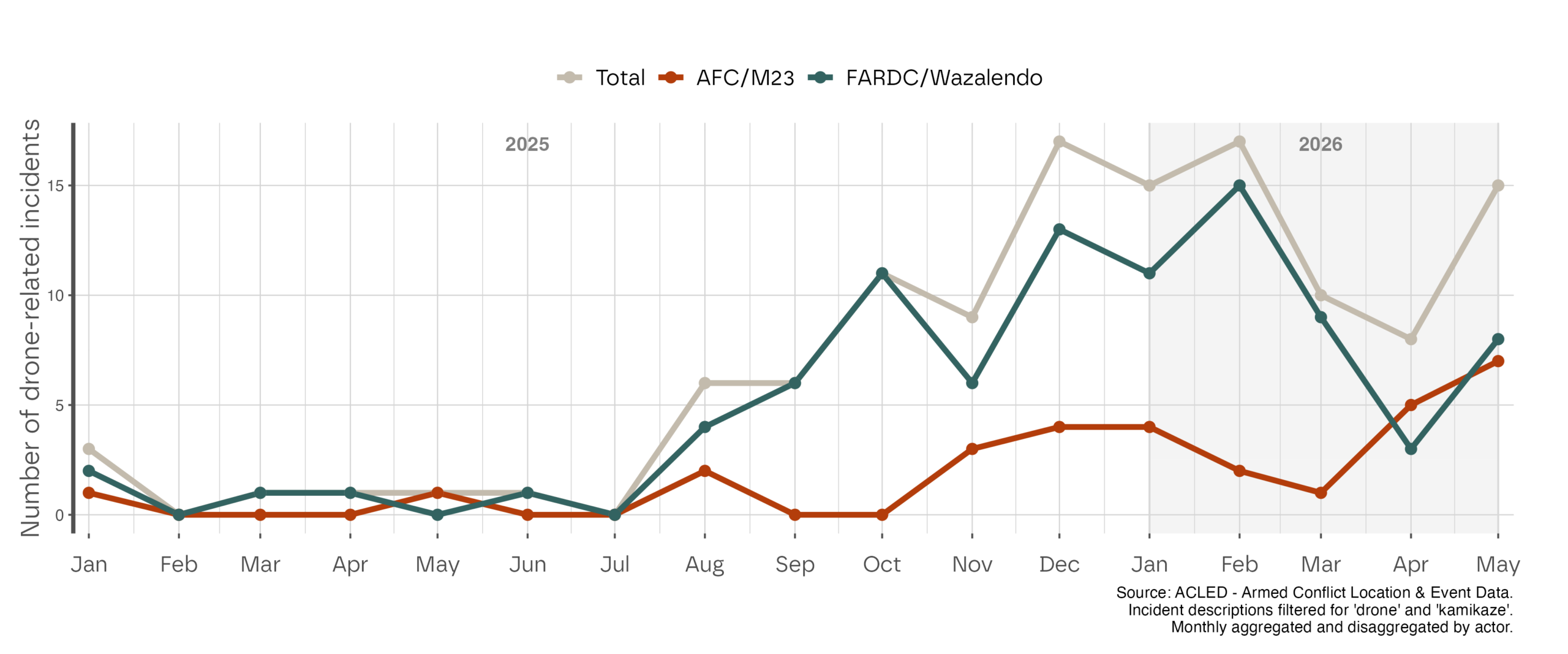
The growing use of drones also expands the geographic scope of the conflict to areas where the AFC/M23 does not hold territorial claims. In February and March 2026, the AFC/M23 claimed responsibility for drone strikes targeting Kisangani Airport (Tshopo province), located 500 km northwest of Goma, as the airport was allegedly used by FARDC to launch drone operations. The latest attack on the Kisangani airport occurred on May 24, when FARDC’s defence system intercepted several armed drones.
North Kivu: Strategic mining areas at the frontline
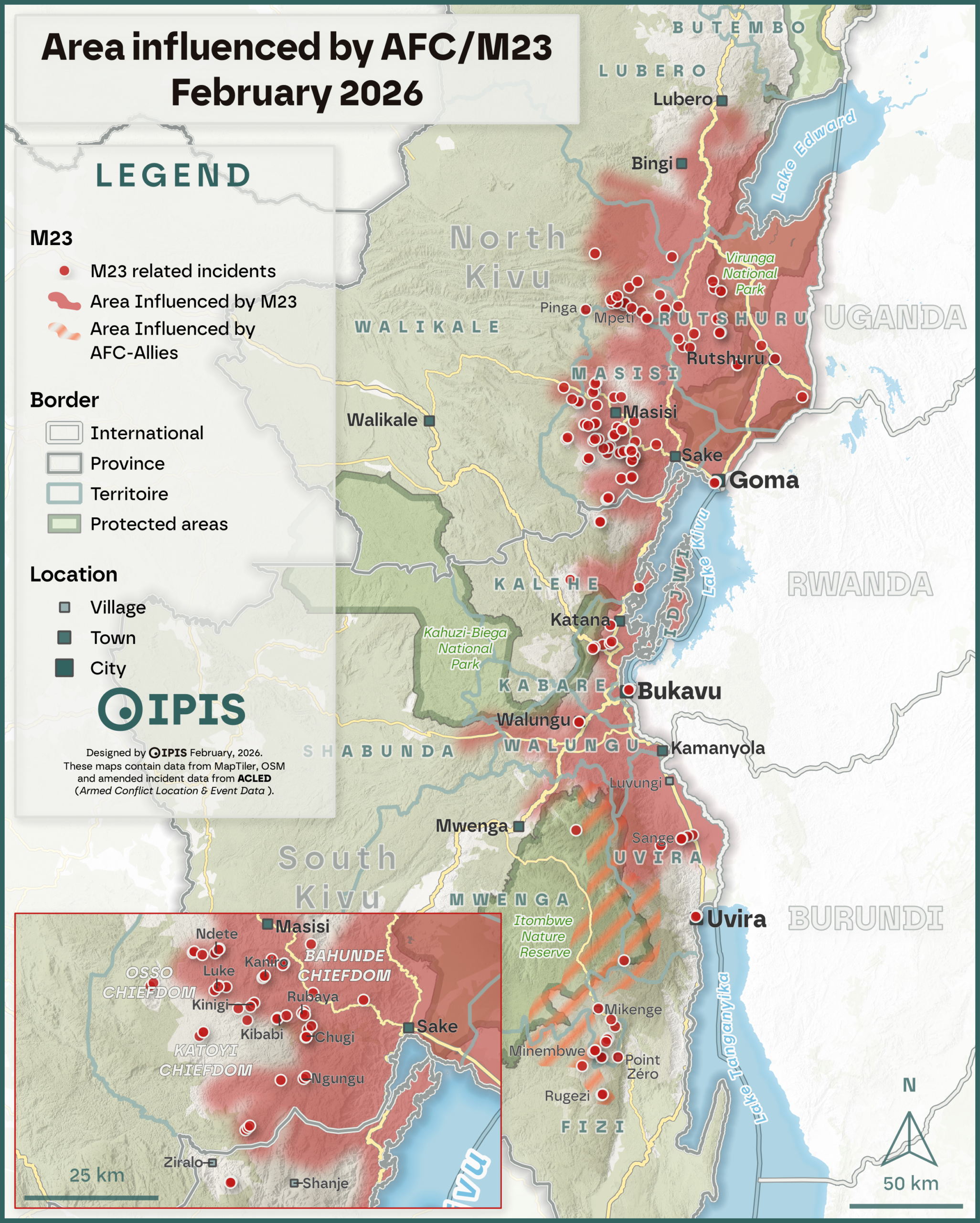
By late February 2026, intense clashes erupted in Masisi territory (North Kivu), where the pro-government Wazalendo coalition launched a large-scale offensive on AFC/M23 positions in the Osso and Bahunde chiefdoms south of Masisi town, attempting to advance towards the important mining town of Rubaya (Masisi, North Kivu). Supported by FARDC air strikes, Wazalendo fighters temporarily recaptured several villages, notably Chugi, Kibabi and Kaniro (Bahunde chiefdom). These villages are of strategic importance, as they block secondary access roads to Rubaya.
AFC/M23, however, quickly regained control of these localities and, crucially, retains control of the coltan mines around Rubaya. Coinciding with these clashes, on February 24, an FARDC drone strike killed AFC/M23’s military spokesperson Willy Ngoma.
Heavy fighting resumed in late May, after a FARDC/Wazalendo offensive captured several villages in the Katoyi chiefdom (Masisi territory). With the pro-government forces advancing again towards Rubaya, national media reported that residents fled the rising levels of violence in this strategic area. According to OCHA, the ongoing hostilities in North Kivu had increased the number of displaced people in the province to 1.27 million during the first trimester of the year.
Tactical withdrawals and new frontlines
By late March, reports indicated that AFC/M23 fighters had withdrawn from several positions in Lubero territory (North Kivu) and along the northern Masisi – Walikale border (North Kivu). North Kivu’s military governor, Évariste Kakule Somo, confirmed the withdrawal of primarily RDF forces to Radio Okapi, describing the move as part of the implementation of the Washington Accord. However, in Ugandan media, AFC/M23 presented the withdrawal as a ‘strategic rotation of forces’.
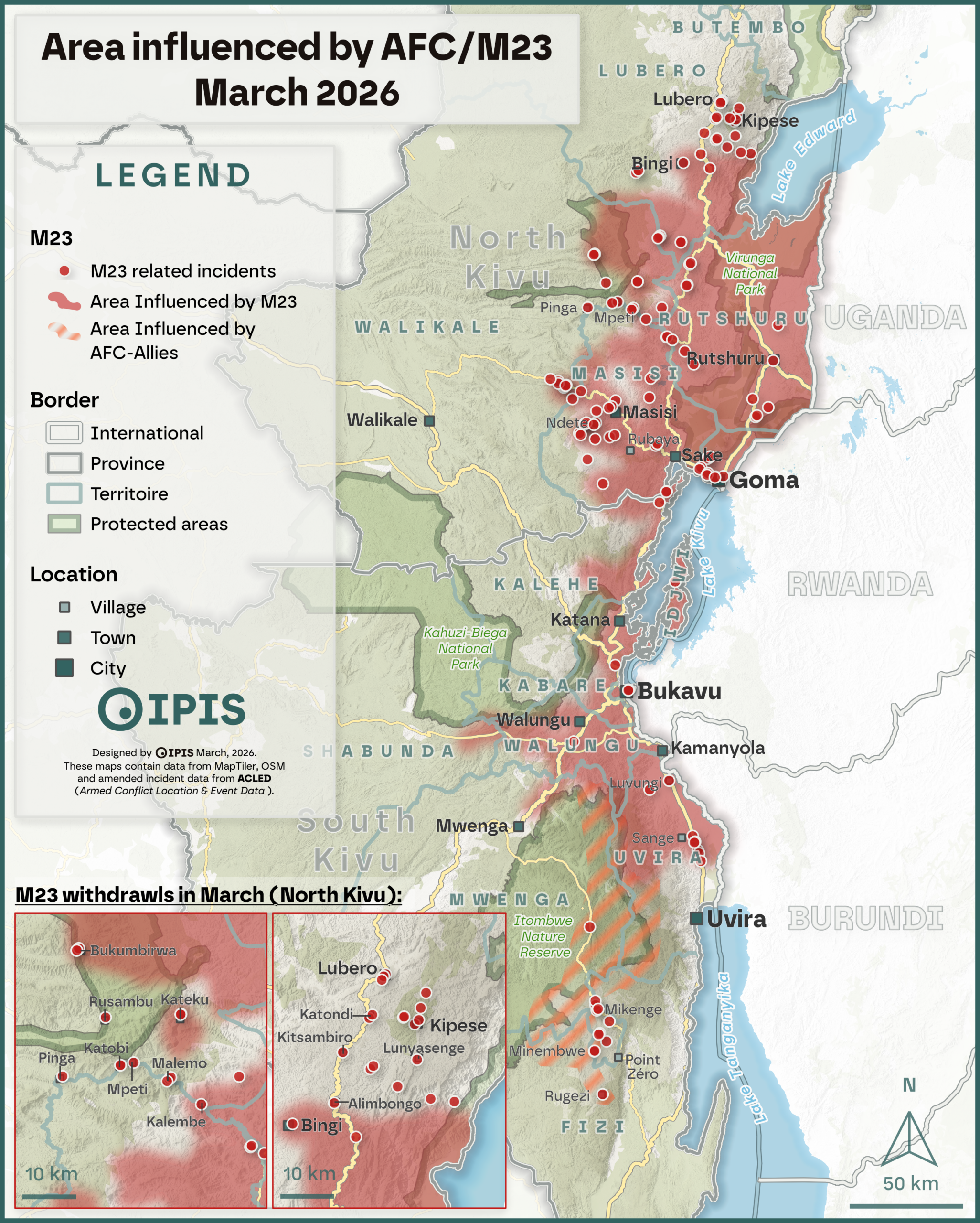
In early April, new frontlines opened in the northern part of Kalehe territory (South Kivu), where AFC/M23 advanced in the Ziralo groupement (Ziralo village indicated in Map 1&3), burning down houses along the Bunje-Katale axis and seizing several localities. While FARDC/Wazalendo partly repelled the offensive, the clashes in the Ziralo groupement displaced at least 13,000 people.
In early May, reports emerged of AFC/M23 troops withdrawing from their positions in the Ruzizi Plain towards Kamanyola and Katogota (Uvira, South Kivu), marking the most significant territorial shift in recent months. The withdrawal reportedly followed renewed pressure from the United States and was described by the AFC/M23 as deliberate “repositioning” and a gesture of good faith within the ongoing peace processes. However, local sources suggest that the withdrawal from the Ruzizi Plain was in response to the clashes in Masisi territory, which prompted the AFC/M23 to reinforce their positions around Rubaya. The move also coincided with intensified military offensives by Burundian-backed Wazalendo groups operating in Uvira territory. The FARDC/Wazalendo subsequently redeployed to the vacated areas in the Ruzizi Plain.
Coalitions in South Kivu’s highlands: Escalating violence and humanitarian crisis
In the highlands of South Kivu, particularly at the border between Mwenga and Fizi territories, intense clashes erupted between the AFC/M23 and their allies on one side, and FARDC/Wazalendo and the Force de Défense Nationale du Burundi (FDNB), which has deployed several thousand soldiers in South Kivu, on the other.
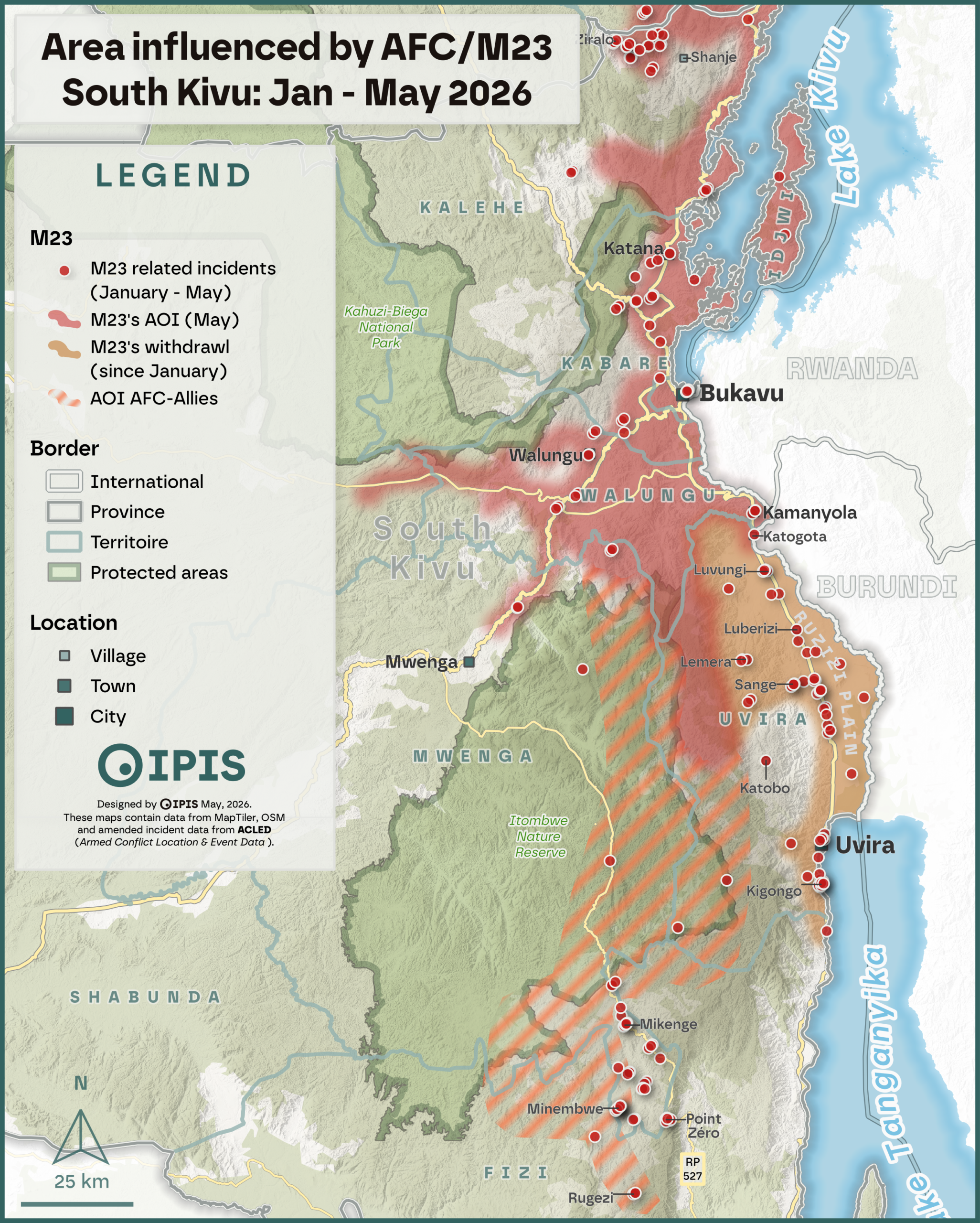
In February and March, pro-government forces regained control of several localities in the High Plateau along the RP527 road, northeast of the AFC/M23-controlled town of Minembwe (Fizi territory). These predominantly Banyamulenge villages, including Mikenge, had previously been controlled by the Twirwaneho movement and other AFC-aligned forces. The area is considered strategically important due to its location along mineral transport routes leading to Fizi’s major ports on Lake Tanganyika. Mikenge, in particular, served as a logistical centre and observation post and had been a stronghold for AFC-aligned forces overseeing the access roads towards Minembwe.
The area had experienced extensive airstrikes by the FARDC/Wazalendo coalition, which repeatedly caused civilian casualties, as reported by Human Rights Watch (HRW). Additionally, HRW indicates that “Twirwaneho had also blocked civilians from leaving Minembwe, despite ongoing attacks in the area, to protect itself from attack and bolster its image as a ‘local defense’ group” (HRW 14 April 2026).
During the offensive, several M23 and Twirwaneho fighters surrendered to FARDC forces. Some of those who surrendered were reportedly no older than 16 and were forcibly recruited by Twirwaneho. In total, over 260 AFC/M23 fighters surrendered to FARDC across North and South Kivu in February and March 2026.
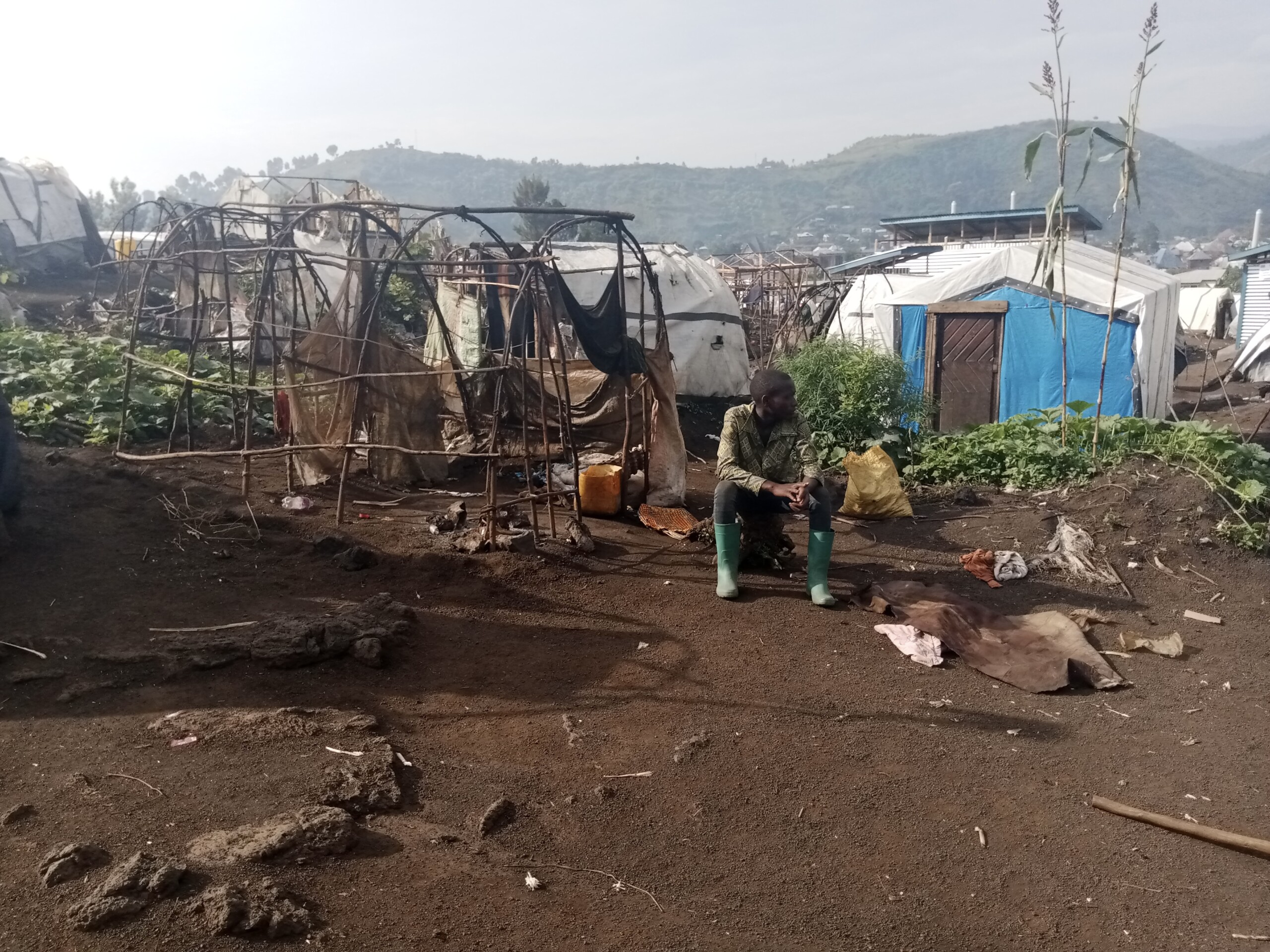
The humanitarian situation in the South Kivu highlands, encircled by FARDC/FDNB/Wazalendo, continues to deteriorate. Ongoing hostilities have blocked humanitarian and medical assistance in the region for over one year. At the same time, prices for basic goods are often five times higher than in other cities in the DRC, partly due to reduced agricultural production. In addition to the worsening humanitarian conditions in the Banyamulenge communities of the Itombwe Massif, civilians continue to live in fear of forced recruitment by the Twirwaneho, or looting and arbitrary arrest by FARDC/Wazalendo fighters.
Human rights under threat: Human rights defenders become targets
Serious human rights violations and arbitrary arrests continue to be reported in areas under AFC/M23 control throughout the first half of the year, amid diplomatic efforts to improve the humanitarian situation in conflict-affected areas. Reports from both North and South Kivu documented cases of arbitrary abductions, sexual violence, torture and killings of civilians. But also other non-state armed groups, fighting under the Wazalendo banner, are accused of looting, pillaging and sexual violence, as reported by Amnesty International.
Especially Journalists, medical staff, and human rights defenders face increasing violence by AFC/M23. In February 2026, UN experts publicly condemned the violence by AFC/M23 towards human rights defenders:
“Human rights defenders operating in the Kivu provinces are paying an unbearable price,” (..) “Those who dare to denounce abuses by M23 are being deliberately targeted (…).” (OHCHR 26 February 2026)
Further reading

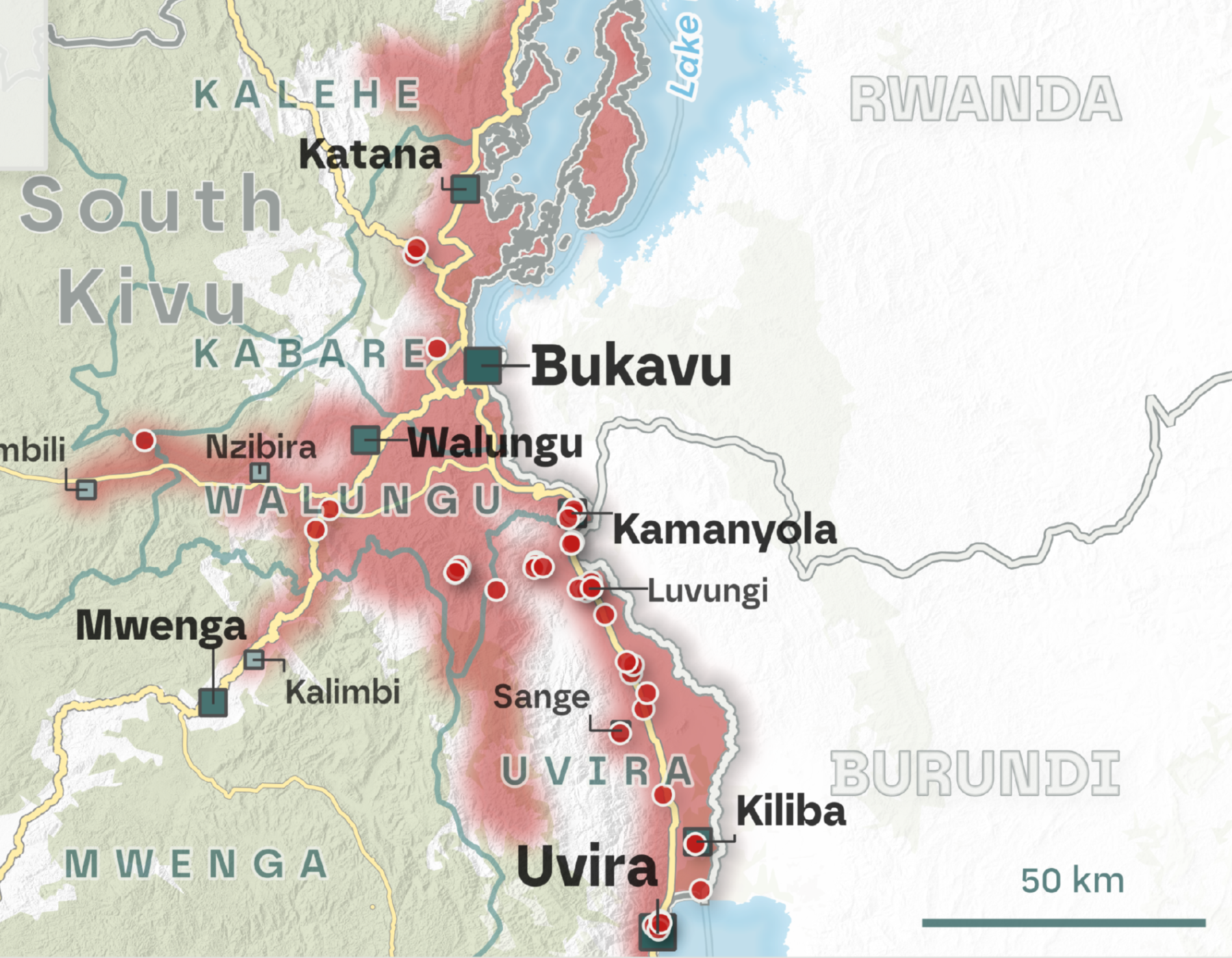
All M23-related maps designed by IPIS


This publication has been produced with the financial assistance of the Foreign, Commonwealth and Development Office (FCDO) and the Belgian Directorate-General for Development Cooperation and Humanitarian Aid (DGD). The contents of this document can under no circumstances be regarded as reflecting the position of FCDO or DGD.