


New peace agreements from Washington and Doha have brought hope for initiating a pathway to resolve the ongoing M23-conflict in DRC’s eastern territories in recent months. However, after the signing of the Declaration of Principles in Doha on 19 July, direct negotiations between the DRC and AFC/M23 were intended to result in a comprehensive peace agreement and were planned to begin no later than 8 August. By the end of September, however, these negotiations had still not commenced.
The implementation of the Washington agreement was also hampered by differing interpretations by the DRC and Rwanda regarding the sequence of key steps: notably the withdrawal of Rwandan troops and the neutralisation of the Democratic Forces for the Liberation of Rwanda (FDLR). At a Joint Security Coordination Mechanism meeting held in Washington in mid-September, both parties have now committed to begin the implementation on 1 October.
Despite the new permanent ceasefire agreed on in Doha, continuous clashes between the AFC/M23 and the FARDC-Wazalendo coalitions persist in the DRC’s North and South Kivu provinces. While MONUSCO welcomed the initial step towards peace and highlighted the Doha declaration’s emphasis on the protection of civilians, new severe human rights abuses spiked in North Kivu, marking July as one of the bloodiest months since the resurgence of the conflict.
Meanwhile, the M23 continues its efforts to establish a parallel government in the occupied territories. In this regard, AFC/M23 reported the establishment of an autonomous judicial system in areas under their control, following an assessment of over 500 magistrate candidates in Goma. DRC authorities have rejected the legitimacy of these actions and intend to annul all court decisions made by the rebellion. The Minister of Communication and Media has also stated that these initiatives violate the Doha Declaration of Principles, which calls for the complete restoration of state authority.
North Kivu – Civilians in the crossfire or primary targets?
Amidst the ongoing mediation efforts and the signing of agreements, the security landscape in the North Kivu Province has remained highly volatile over the past months. Clashes between the M23 and Wazalendo self-defence groups, supported by the Congolese army (FARDC), have intensified once again, resulting in high numbers of civilian casualties, mass displacement and territorial changes.

In Rutshuru’s Bwito chiefdom, clashes between the M23 and Wazalendo defence groups persisted as part of M23’s broader campaign to eradicate opposing armed groups, especially FDLR, from the region. Concerning reports also surfaced from the neighbouring Bwisha chiefdom (Rutshuru territory), where the M23 carried out massacres of civilians in July and August, accusing them of being affiliated with the FDLR. The UN High Commissioner for Human Rights, Volker Turk, estimated that more than 300 civilians had been killed in the Rutshuru territory during July alone.
« The M23 armed group, which has Rwandan government backing, attacked over a dozen villages and farming areas in July and committed dozens of summary executions of primarily Hutu civilians » stated by Clementine de Montjoye (HRW, 20/08/2025 ).
To sustain fighting along the frontlines and to bolster its ranks, the M23 continues (forced) recruitment efforts in its 11.500km2 occupied areas. By mid-September, they presented over 7.400 new recruits who had just completed six months at the Rumangabo (Rutshuru, North Kivu) military training camp. Reports have also surfaced about inhumane conditions at Rumangabo, following testimonies from suspected M23 members detained in Kisangani. One of them highlighted:
« I was treated like an animal, with no clothes or pay, and food was scarce. We slept in the forest, in holes called trenches. That’s why I decided to escape this suffering. » (free translation from French; Radio Okapi 26/09/2025)
These new recruits are crucial for consolidating M23’s control and their gradual expansion of influence, as they have reinforced their positions along the western frontline at the border between Masisi and Walikale territory. West of Masisi town, the M23 launched repeated attacks on Wazalendo positions in the Osso chiefdom, seizing new villages and territory throughout July and August. The operations led to massive displacement of the local population, many of whom fled towards villages and forests in the Waloa Yungu groupement (Walikale, North Kivu).
The rebel group also attempted to push northwards from Masisi towards Pinga (on the border with Walikale territory), but Wazalendo fighters successfully disrupted their progress along the Nyabiondo-Pinga axis by mid-September. Nevertheless, the M23 has reinforced its positions east and north of Pinga in the Kisimba and Ikobo groupements of Walikale territory, in preparation for a larger attack on Pinga, which holds a strategic airstrip. Local leaders claim Pinga’s capture risks destabilising Walikale town, as it enables the M23 to use this position to resupply with weapons and ammunition during further operations in the Walikale territory.
Late September, the FARDC-Wazalendo coalition launched a counteroffensive to repel the M23’s advances towards Pinga, supported by airstrikes in the Kisimba groupement (Walikale territory) and Bashali Moko groupement (Masisi territory), which destroyed the Minjenje bridge on the road RP1030 between Kalembe and Mpeti. In retaliation, M23 fighters set fire to homes in two villages in the Kisimba groupement, further worsening the humanitarian situation along the frontlines. Additionally, the M23 launched bombardments and conducted cordon and search operations against civilians seeking refuge from the clashes in nearby forests. This resulted in the death of more than 25 people and the arrest of dozens of civilians, who have been brought to rebel positions in Buleause in the Ikobo groupement. The Ikobo groupement is now completely under M23 control and reports surface of the M23 forcing the local population to carry weapons and ammunition to help reinforce their positions.
South Kivu – New fronts and coalitions
Also in South Kivu, fighting persisted throughout July, August and September. While the M23 was able to occupy several new localities in the Irhimba-Katana groupement (Kalehe territory) in July, the M23 withdrew from the closeby city of Katana in August, to consolidate its positions further south in the Walungu and Uvira territories.
Throughout August, the Walungu territory experienced heavy clashes. FARDC/Wazalendo claimed it withdrew from key localities, such as Kaniola and Mulamba, to prevent bloodshed in these densely populated areas. Nevertheless, fighting escalated further in September, resulting in M23’s capture of Nzibira. Nzibira is an important mineral-trading town, strategically located on the axis towards Shabunda and Mwenga territories, and its capture risks enabling the M23 to advance further west.
In August, reports of new joint operations with AFC/M23-allies also resurfaced further south, in the Mwenga and Fizi territories. The M23-Tirwanhero-RED-Tabara coalitions reportedly clashed with government forces in Fizi’s Mutambala chiefdom, where they attempted to seize control of mining sites around Rugezi.
These operations illustrate the extension of AFC/M23’s influence through alliances with other armed groups. The Twirwaneho movement – rooted among Banyamuele self-defence militias who operate in the highlands of Mwenga and Fizi – and the RED-Tabara, a Burundian armed group active along the DRC–Burundi border, have long operated with overlapping objectives and are leveraged by AFC/M23 to stretch the frontlines in South Kivu, aiming to disperse FARDC forces.
Despite continuous national and international political efforts to end the conflict, the security situation in eastern DRC’s Kivu regions continues to escalate. Both parties have repeatedly violated the ceasefire, eroding the credibility of recent peace agreements. The persistence of violence, forced recruitment and mass displacement of civilians, despite the Doha Declaration’s emphasis on civil protection, highlights the disconnect between political commitments and realities on the ground. Without effective monitoring mechanisms, accountability and inclusive dialogue, the conflict risks entrenching a fragmented eastern DRC marked by prolonged instability and human suffering.
Further reading
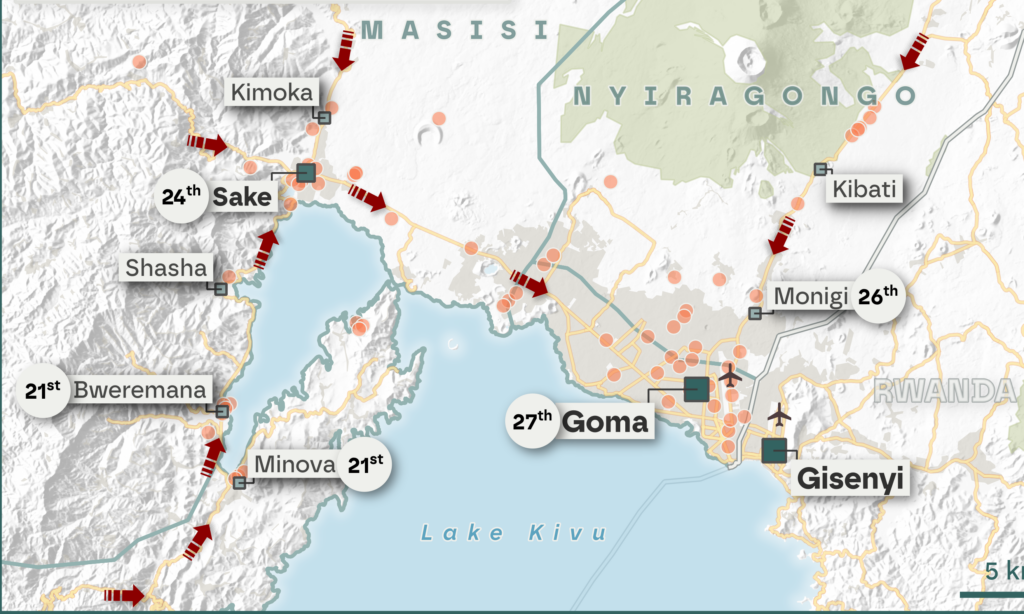
All M23-related maps designed by IPIS


This publication has been produced with the financial assistance of the Belgian Directorate-General for Development Cooperation and Humanitarian Aid (DGD). The contents of this publication are the sole responsibility of IPIS and can under no circumstances be regarded as reflecting the position of the Belgian Development Cooperation.