
The mining sector of the Central African Republic (CAR) is entering a new phase, but its trajectory remains uncertain. A revised mining code, the lifting of the Kimberley Process conflict diamond embargo and a rapidly expanding gold sector may create new opportunities for investment and public revenues. At the same time, CAR’s suspension from the Extractive Industries Transparency Initiative (EITI) exposed gaps in civil society participation, contract disclosure and beneficial ownership transparency. Persistent concerns around conflict, elite capture and mercenary-linked business actors raise further questions about oversight and who ultimately benefits from the country’s mineral wealth. Together, these developments underline the need for greater transparency. To help address this gap, IPIS launched this interactive dashboard that visualises officially published mining permits and brings together contextual information on permit holders, companies, representatives, including their links to foreign countries and actors.
In August 2024, after nearly four years of discussions and with support from the World Bank, CAR adopted a new mining code. The reform was presented as an effort to reduce informality, attract investment, increase public revenues and improve transparency in the sector. Only three months later, in November 2024, CAR was suspended by the EITI, following a validation that identified breaches of the EITI civil society protocol and gaps in contract and beneficial ownership disclosure.
That same week, the KP lifted its embargo on CAR diamonds, citing improved conditions. The embargo had been introduced when civil war broke out in 2013, and was partially lifted in 2015 for compliant zones in the west of the country. Its full removal in 2024 reinstated CAR as a full participant in the global diamond trade.
These developments create both hopes and concerns. They may open space for more formal investment and stronger state revenues, but they also raise questions about oversight, accountability and who benefits from renewed mining activity.
Minerals, conflict and political power
Diamonds have long dominated CAR’s mining economy, but gold has become increasingly important in recent years. This shift has been driven by an artisanal gold rush, the expansion of semi-mechanised mining – often involving Chinese operators – and the development of the country’s first large-scale gold operation at Ndassima by Midas Ressources, reportedly linked to the business network of the Russian mercenary group Wagner. Reported data indicate that CAR’s gold production rose sharply from just under 1 tonne in 2021 to more than 7 tonnes by 2025, although this is still considered to understate the country’s actual production.
Minerals have long been intertwined with conflict, crime, corruption and political power in CAR. Building on the legacy of colonial extraction, successive governments have used the mining sector to consolidate influence, reward patronage networks and concentrate wealth. This has fuelled frustration among an impoverished population and created fertile ground for rebellion. Armed groups, in turn, have used mining and mineral trade to finance their activities.
The country’s mineral wealth did therefore not result in broad-based development. CAR remains one of the poorest countries in the world, ranking 191st on the Human Development Index. Food insecurity also remains acute, with violence and displacement disrupting farming and livelihoods.
Since 2021, government forces, supported by Wagner mercenaries and Rwandan bilateral forces, have regained control over large parts of the country for the first time in more than a decade. This counterinsurgency campaign has come at a heavy cost for civilians, with widespread reports of human rights abuses, particularly by Wagner forces. Rebel groups, pushed back towards border areas, have shifted from extensive territorial control over mining sites to hit-and-run attacks, banditry and predation. Key mining hotspots across the country continue to experience violence affecting artisanal miners, while foreign operators, often Chinese, have been targeted in attacks and kidnappings.
Tracking renewed mining interest through public permit data
Renewed state control over several mining areas has strengthened the government’s confidence in the sector and appears to coincide with growing investor interest. As part of transparency efforts associated with EITI implementation, CAR’s national secretariat for EITI has published a range of mining contracts and related documents, including information on permit coordinates, companies and company representatives.
IPIS manually reviewed these documents and structured the information into a dataset. The available documents show more than 50 new industrial licences issued in 2025 alone, including exploration permits, small-scale industrial permits and large-scale mining licences. Publicly available information for 2026 remains limited, although available video records of Council of Ministers meetings indicate that new permits continue to be issued.
The data also show growing interest in CAR’s critical and strategic minerals. Since 2021, around 20 large-scale exploration permits have been issued for minerals such as lithium, cobalt, nickel, copper and uranium.
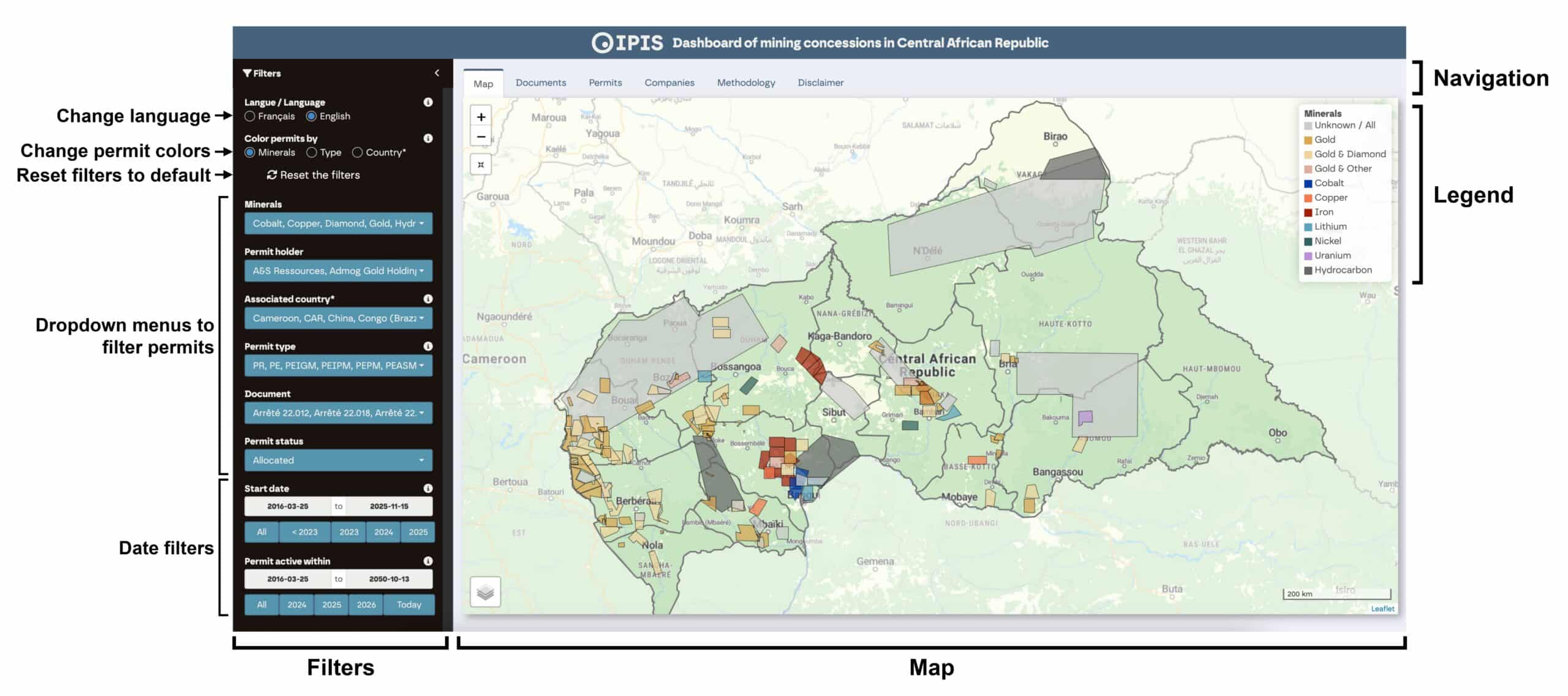
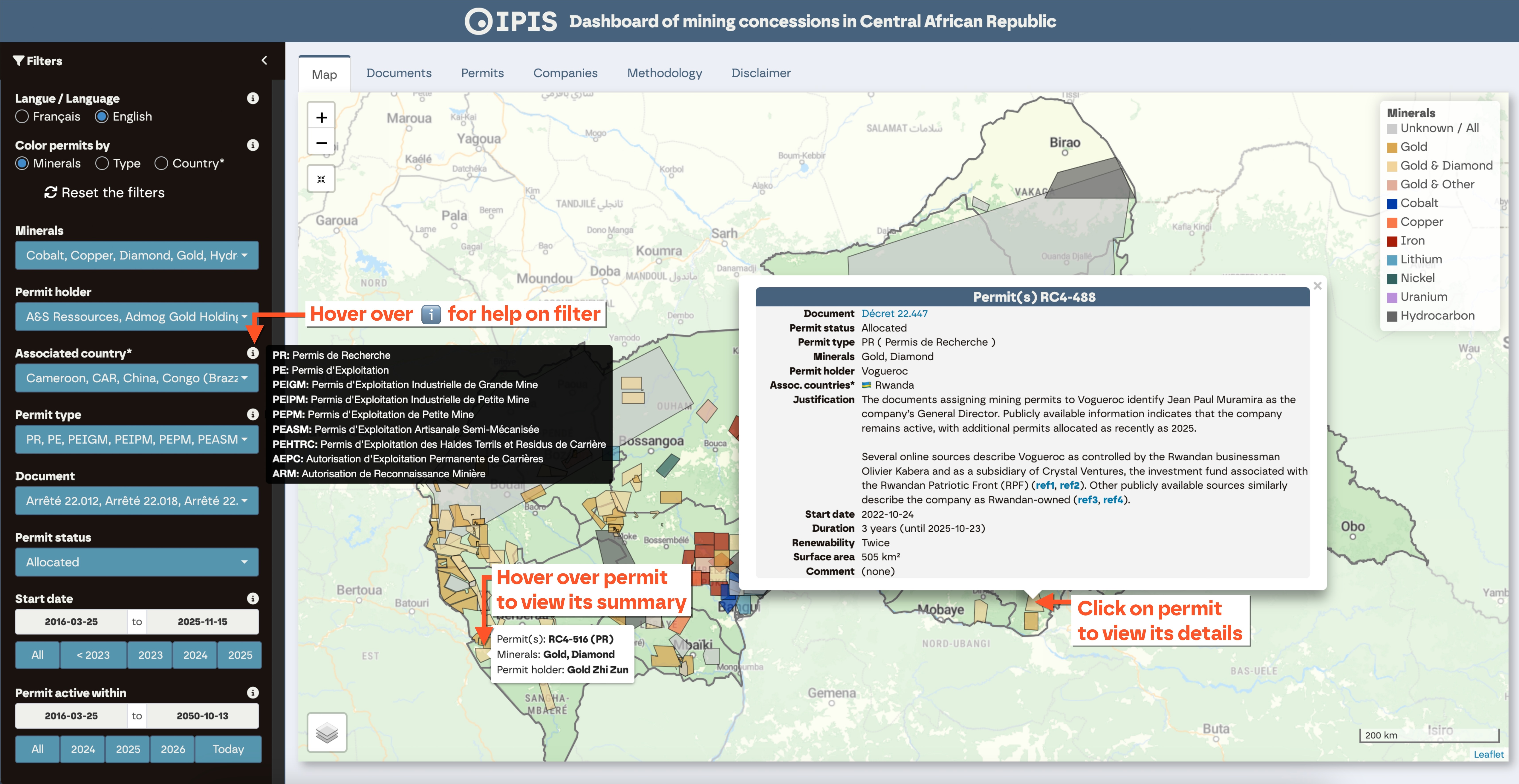
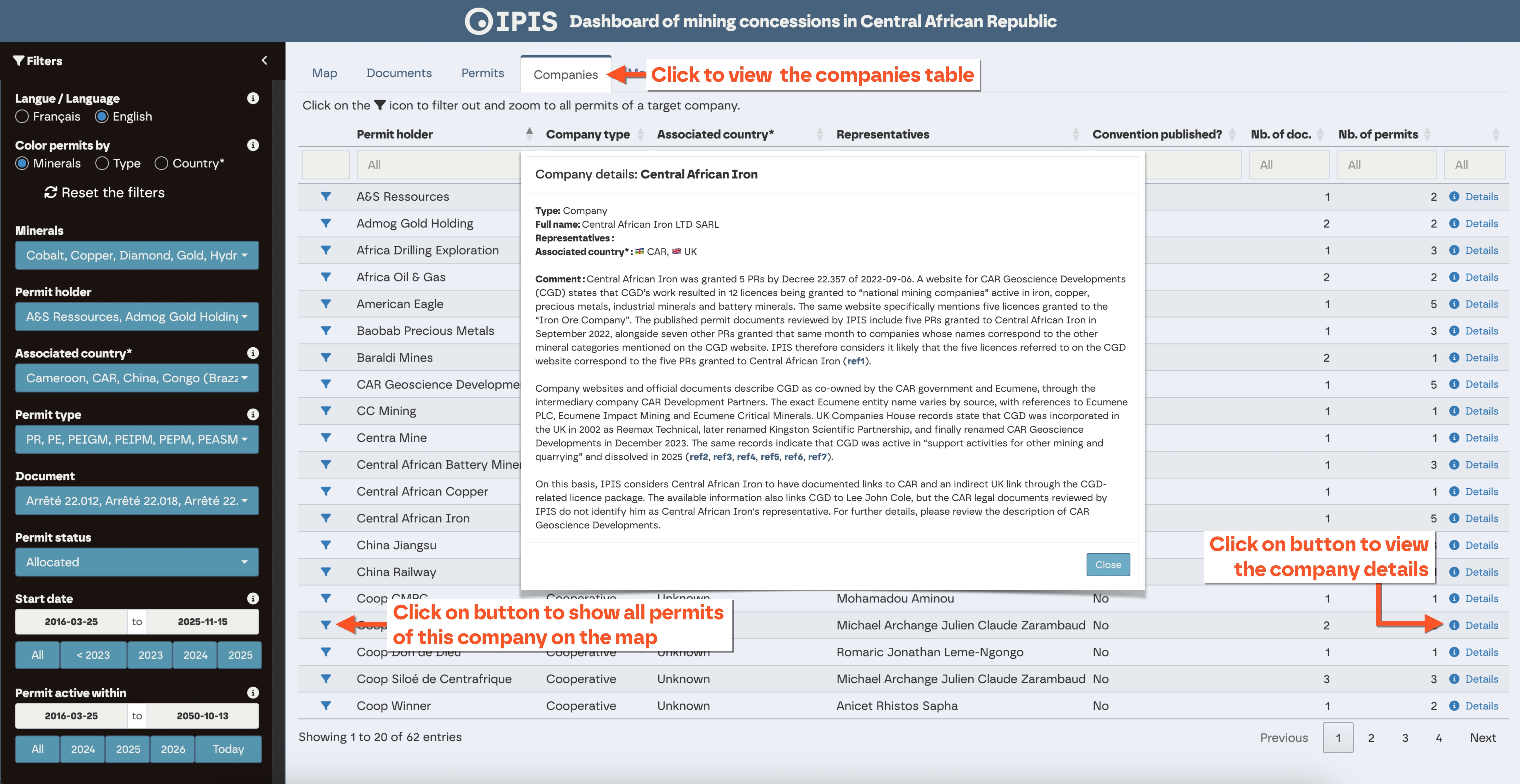
IPIS’ interactive dashboard serves to make this information easier to explore. The tool allows users to visualise mining permits, filter them by key characteristics, and access contextual information on permit holders, representatives and possible country associations. This information is based on official documents and complemented by open-source research, including reporting by the UN, companies, civil society and media.
What permit data reveal, and what remains hidden
The dashboard reveals a diverse set of companies and permit holders. Most are little-known entities, with limited publicly available information. IPIS’ research identified links to a wide range of countries through company registration, ownership structures, representatives or related companies, including China, Russia, Rwanda, United Arab Emirates and several European and African countries.
However, the available information often remains incomplete. In many cases, it is difficult to identify beneficial owners or to determine whether companies are operational, speculative or inactive. These gaps are especially concerning in a sector marked by persistent reports of criminality and corruption. CAR’s gold trade, in particular, has evolved into a hybrid system in which official channels and parallel networks often overlap. This raises important questions about public revenue, oversight and the distribution of benefits.
CAR Geoscience Developments: an illustrative example of complex company linkages
In 2023, the little-known CAR Geoscience Developments (CGD) was allocated five large early-stage exploration titles for “all minerals substances”, covering 130,000 km² in total – an area comparable to Greece and more than four times the size of Belgium.
Company websites and official documents describe CGD as represented by Lee John Cole and co-owned by the CAR government and Ecumene, through the intermediary company CAR Development Partners. The exact Ecumene entity name varies across sources, with references to Ecumene PLC, Ecumene Impact Mining and Ecumene Critical Minerals.
UK Companies House records state that CGD was incorporated in the UK in 2002 as Reemax Technical, renamed Kingston Scientific Partnership shortly afterwards, and renamed CAR Geoscience Developments in December 2023. The company was active in “support activities for other mining and quarrying” and dissolved in 2025. The same records indicate that Linden Boyne had been the company’s director since 2009.
Although these records do not mention Lee John Cole, he and Boyne appear together in several other public reports. They were charged with fraud by the US Securities and Exchange Commission in relation to their roles as executive officers of Electronic Game Card Inc., were shareholders in the collapsed First London investment bank, and were reportedly involved in a mining deal with North Korea through EG Mining.
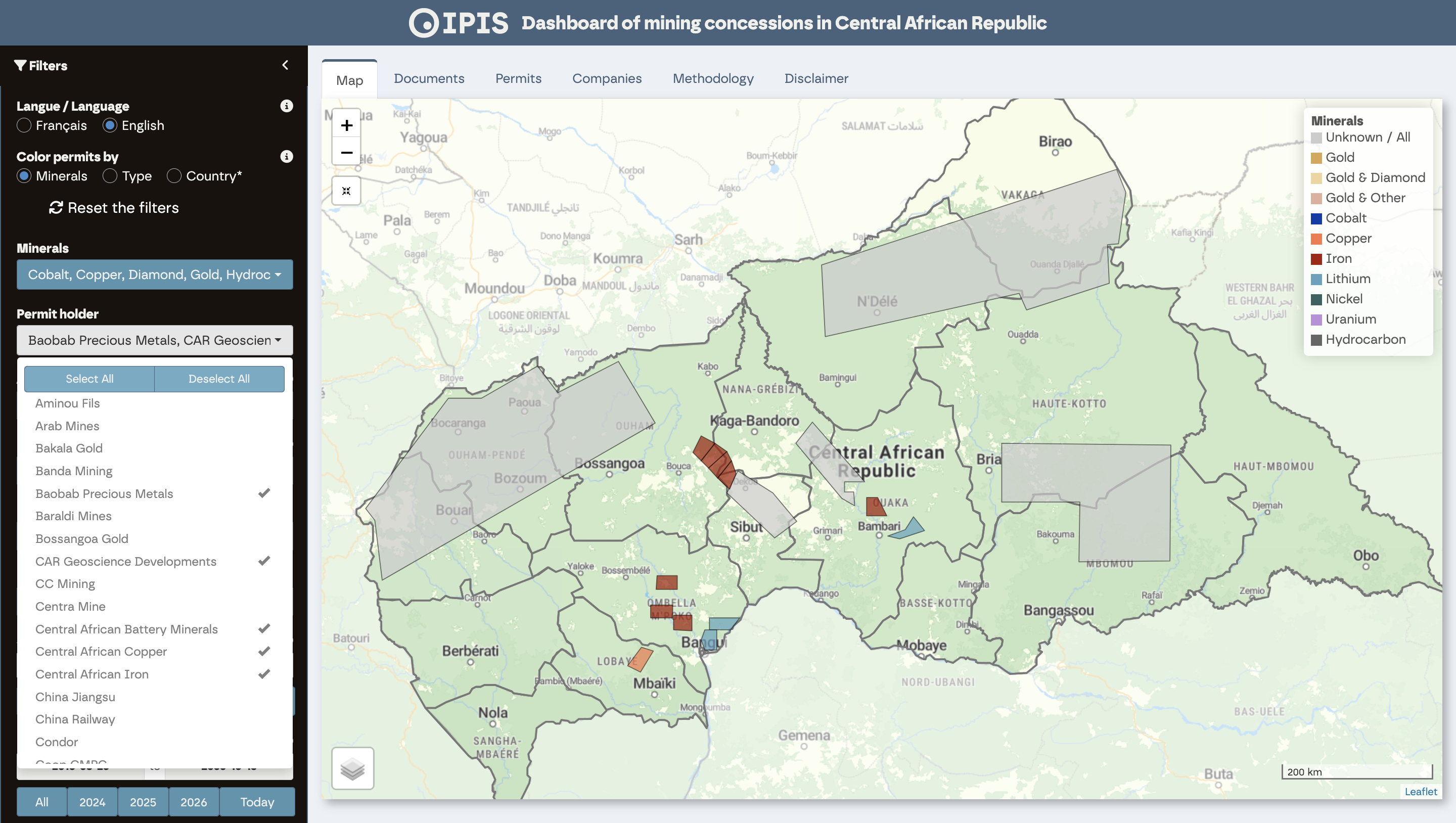
CGD’s website also states that its work resulted in 12 licenses being granted to “national mining companies” active in iron, copper, precious metals, industrial minerals and battery minerals. This appears to correspond to a broader package of 12 exploration permits granted in September 2022 to Central African Iron, Central African Copper, Central African Battery Minerals and Baobab Precious Metals, companies for which little additional public information could be found. Most follow a similar “Central African [mineral]” name structure. Baobab Precious Metals does not, but its permits were granted on the same date as several of the others, and one of its permit areas fits tightly between two permits assigned to Central African Iron.
This example does not provide a complete picture of CGD’s ownership, activities or role in CAR. It does show why permit data alone is insufficient, and why additional transparency on company structures, representatives and related business networks is needed to support meaningful public oversight. More information on CGD, its permits and the sources used for this assessment can be found in the dashboard.
Why transparency matters
Improving transparency in CAR’s mining sector is not a technical issue only. As also highlighted by the International Monetary Fund (IMF), it is a precondition for better sector oversight, stronger public revenue management, more responsible investment and reduced risks of corruption, elite capture and conflict financing.
This is also central to any future effort to address CAR’s EITI suspension, with the next validation expected in 2028. More accessible information on permits, companies and ownership structures can support evidence-based policymaking, help responsible investors assess risks and opportunities, and strengthen public scrutiny by civil society, journalists and other stakeholders.
The need for accessible information is even more pressing because field-based monitoring remains very difficult. CAR continues to be one of the most dangerous environments for humanitarian and civil society actors. Insecurity, access restrictions and pressure on journalists and researchers limit independent monitoring of mining areas, while also UN peacekeepers and experts face constraints in accessing information and conducting field investigations.
This makes it all the more important to organise and open up the information that is available. CAR does not yet have a digital public mining cadastre system, although plans to develop one with World Bank support have been reported. IPIS’ review of official documents also identified inaccuracies in coordinates and overlaps between permits, confirming EITI’s observation that rebuilding an accurate list of active mining rights will require extensive data cleaning.
This dashboard does not replace an official cadastre, nor does it provide definitive information on ownership or activity on the ground. Instead, it aims to make scattered public information more accessible, searchable and useful for policymakers, researchers, civil society, journalists, and other stakeholders interested in CAR’s mining sector.
More on the dashboard functionalities

This dashboard has been produced with the financial assistance of the European Union. Its contents and this publication can under no circumstances be regarded as reflecting the position of the European Union.