
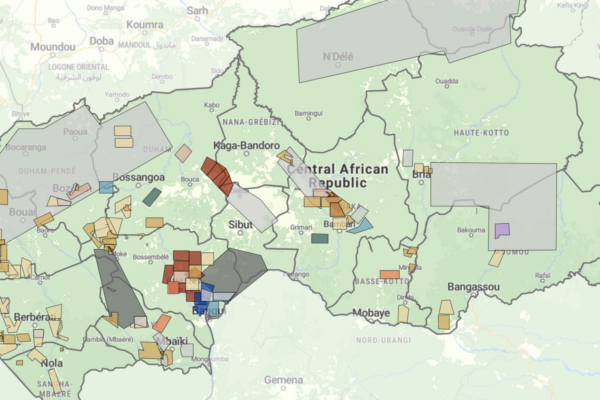
Mapping mining permits in the Central African Republic: A new dashboard to support extractive sector transparency
June 25, 2026The mining sector of the Central African Republic is entering a new phase, but its trajectory remains uncertain. A revised mining code, the lifting of the Kimberley Process conflict diamond embargo and a rapidly expanding gold sector may create new opportunities for investment and public revenues. At the same time, CAR’s suspension from the Extractive Industries Transparency Initiative (EITI) expo
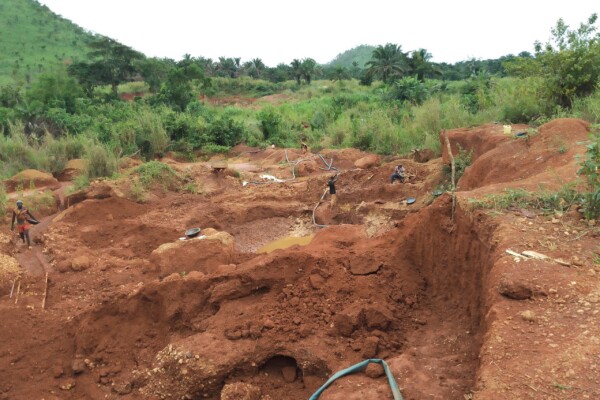
Mapping artisanal mining sites in the Kibali gold mine concession in Faradje territory, Haut-Uélé, DRC
December 8, 2025In the Faradje administrative territory in the northeastern Democratic Republic of Congo’s Haut-Uélé province, more than 5,000 people rely on artisanal gold mining to earn a living and support their families. Many artisanal-mining families have done so for generations. They currently work on sites that now fall largely within mining permits owned by Kibali Goldmines (Kibali), a joint venture of Ba

Why the Kimberley Process is not the answer to today’s mineral governance challenges
November 14, 2025Amid persisting concerns over how mineral exploitation is entangled with conflict, human rights abuses, smuggling, and corruption, the Kimberley Process (KP) keeps resurfacing as a go-to model. Its core approach – a certification scheme meant to ban conflict diamonds, which now account for allegedly less than 1% of the global trade – is being held up as an answer to a wide range of mineral-related

Chinese investment in Tanzania’s small-scale mining: The challenge of technical support and regulatory oversight
April 7, 2025DARUBINI – TANZANIA BRIEFING – MARCH 2025 Chinese investments in Africa’s mineral sector have expanded rapidly in recent years, driven by China’s increased resource demand, the continent’s abundant mineral reserves and the risk-taking entrepreneurial culture among Chinese investors. To address concerns about ethical practices, the China Chamber of Commerce of Metals, Minerals, and Chemicals Import

New project of mapping artisanal and small-scale mining sites in the Central African Republic
May 2, 2019Following a successful training in Bangui with members from civil society organizations and field officers from the Kimberley Process focal point at the Ministry of mines and geology of the Central African Republic (CAR), IPIS will start field based research to map artisanal and small-scale gold and diamond mining sites in Western CAR. This study will focus on quantitative research through Mobile

Kufatilia: a new Incident Monitoring Mechanism for Gold Supply Chains
December 4, 2018“Today a man was killed in a pit collapse in an artisanal mining site near Numbi.” Civil society organizations, working to improve living conditions of artisanal and small-scale miners in Eastern DR Congo, regularly receive this kind of text message. Capture d’écran du système de Suivis des Incidents de l’Or (SIOr) Since a few weeks, incidents linked to the production, transport and selling of mi