
By Patient Birindwa, IPIS Focal Point for the DRC
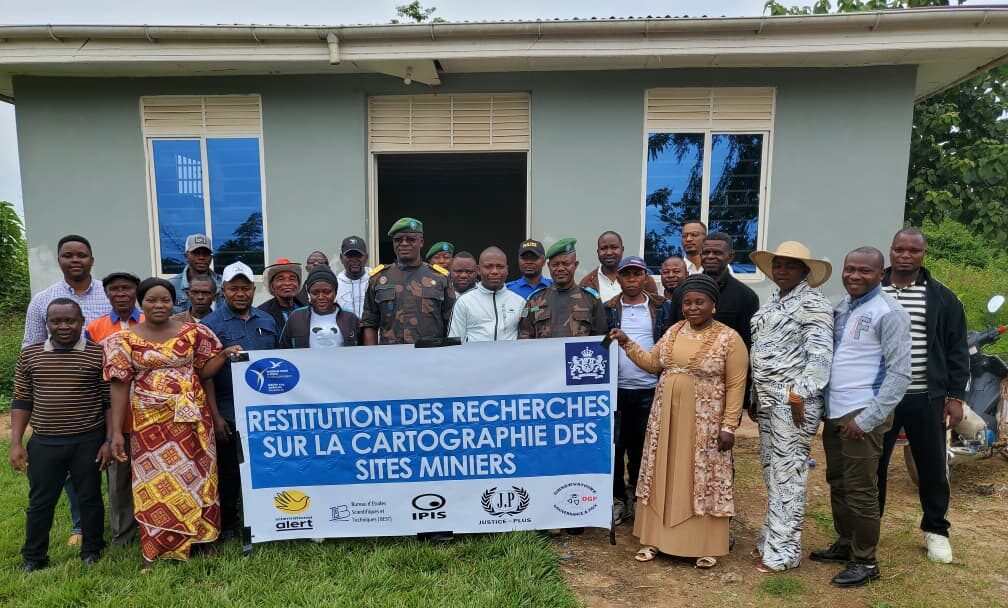
Established in 2019, the “Madini Kwa Amani Na Maendeleo “ (Minerals for Peace and Development) is an initiative of the consortium comprising International Alert, the Observatoire Gouvernance et Paix (OGP), the Bureau d’Études Scientifiques et Techniques (BEST), Justice Plus (JP) and IPIS, with financial support from the Ministry of Foreign Affairs of the Kingdom of the Netherlands.
The project collaborates with local communities, government institutions, the private sector and civil society to improve security, reduce conflict, strengthen governance and promote human rights in the mining areas of South Kivu and Ituri provinces, in eastern DRC. It also encourages cooperation to ensure compliance with international standards for responsible mineral sourcing. In this context, the project supports local and provincial multi-stakeholder structures1 responsible for supervising mining activities, who contribute to the implementation of the project’s activities and the achievement of its objectives.
The project entered its second phase on August 1st, 2024, with the aim of consolidating the achievements of the first phase. It is in this context that IPIS, in charge of qualitative and quantitative research, mapped 75 mining sites in Ituri, in the territories of Djugu, Irumu and Mambasa, between February and April 2025. At each site, the IPIS research team collected qualitative and quantitative data through observations and interviews with various actors, including artisanal miners, site and pit managers, members of mining cooperatives, representatives of state services, traders, as well as local authorities and members of civil society. In total, IPIS interviewed 343 people, including 75 women.
Following this research, the results were presented in workshops in the above-mentioned territories to mining monitoring committees and project stakeholders in August 2025, facilitated by the IPIS focal point, Justice Plus staff and the IPIS research team. The aim of these feedback sessions was to share the results of our research with local actors in order to make them more accessible, enable them to contribute to the exchanges and discussions, enrich them if necessary, and take ownership of and validate the results of the reports.
Workshop proceedings

Once in the field, with the support of Justice Plus and the IPIS research teams, the list of participants for the feedback workshops was adjusted according to the schedule of activities and updated in Mambasa and Irumu, based on the availability of the targeted individuals and the relevance of the selected actors. The first workshop was held on August 19th 2025 in Mambasa Centre, while the second was organised on August 27th 2025 in the village of Olongba, in the territory of Irumu. Due to the security situation, the feedback workshop planned in Djugu could not be organised.
Participants included artisanal miners, site managers, members of mining cooperatives, representatives of security and state services, local authorities, and members of civil society. It should be noted that some of them are members of local committees monitoring mining activities.
The feedback workshops were structured around several key stages, including:
- Presentation of the research results.
- Cross-disciplinary group work.
- Feedback on the cross-disciplinary group work.
- Summarizing the participants’ contributions.
- Formulation of recommendations by the participants.
Reflections on the workshops
At the end of this first experience of local reporting on the results of the mapping of mining sites as part of the project, participants expressed keen interest and confirmed the quality of the data. The presentations gave rise to rich discussions among participants on four main themes (security, state control, social conflicts and tensions, and health). In addition, they discussed several major challenges, including the formalisation of the artisanal sector. Participants expressed a sense of satisfaction, particularly as the Madini project, through IPIS, conducted the research in collaboration with the communities and returned to share the results with them, while incorporating their comments into the reports.

The research confirmed the conflicts and tensions experienced by communities, and the feedback sessions provided an inclusive space for dialogue between stakeholders to discuss these issues freely and formulate recommendations. Moreover, the exchanges allowed for a confrontation of viewpoints, with some asserting that there was no interference in mining activities, while others shared contrary experiences, supported by concrete examples observed at certain sites and roadblocks. The aim of the feedback sessions was to promote, through exchanges and discussions, the emergence of a consensus by holding each stakeholder accountable for their responsibilities. State services notably mentioned the failure of mining stakeholders to comply with certain obligations, while the latter raised the difficulties associated with the multiplicity of services present at mining sites.
Participants also deepened their reflections on the appropriation of the results obtained and formulated a series of recommendations for each of the above-mentioned themes, at different levels of the chain – SCLS (groupements), CLS (chiefdom) and CTS (territory) – as well as for the provincial government, the national government and the Madini Kwa Amani Na Maendeleo project.
Here are some of the recommendations that were made:
- Irumu: To the chiefdoms and territories, in collaboration with multi-stakeholder structures (SCLS, CLS and CTS), to find solutions to identified conflicts related to the administrative boundaries of the various villages in the Baviba group;
- Mambasa: The Madini project should support a CTS and/or CPS to conduct a field visit to gather in-depth information on the actions of certain undisciplined elements of the Armed Forces of the Democratic Republic of the Congo (FARDC) present at 18 of the 38 identified mining sites, and to follow up with the military hierarchy and the competent authorities.
- Committees monitoring mining activities at various levels (sub-local, local, territorial, provincial). ↩︎

The Madini Kwa Amani Na Maendeleo project is funded by the Dutch Ministry of Foreign Affairs and aims to improve security, social cohesion and human rights in the conflict-ridden mineral-rich regions of eastern DRC.