

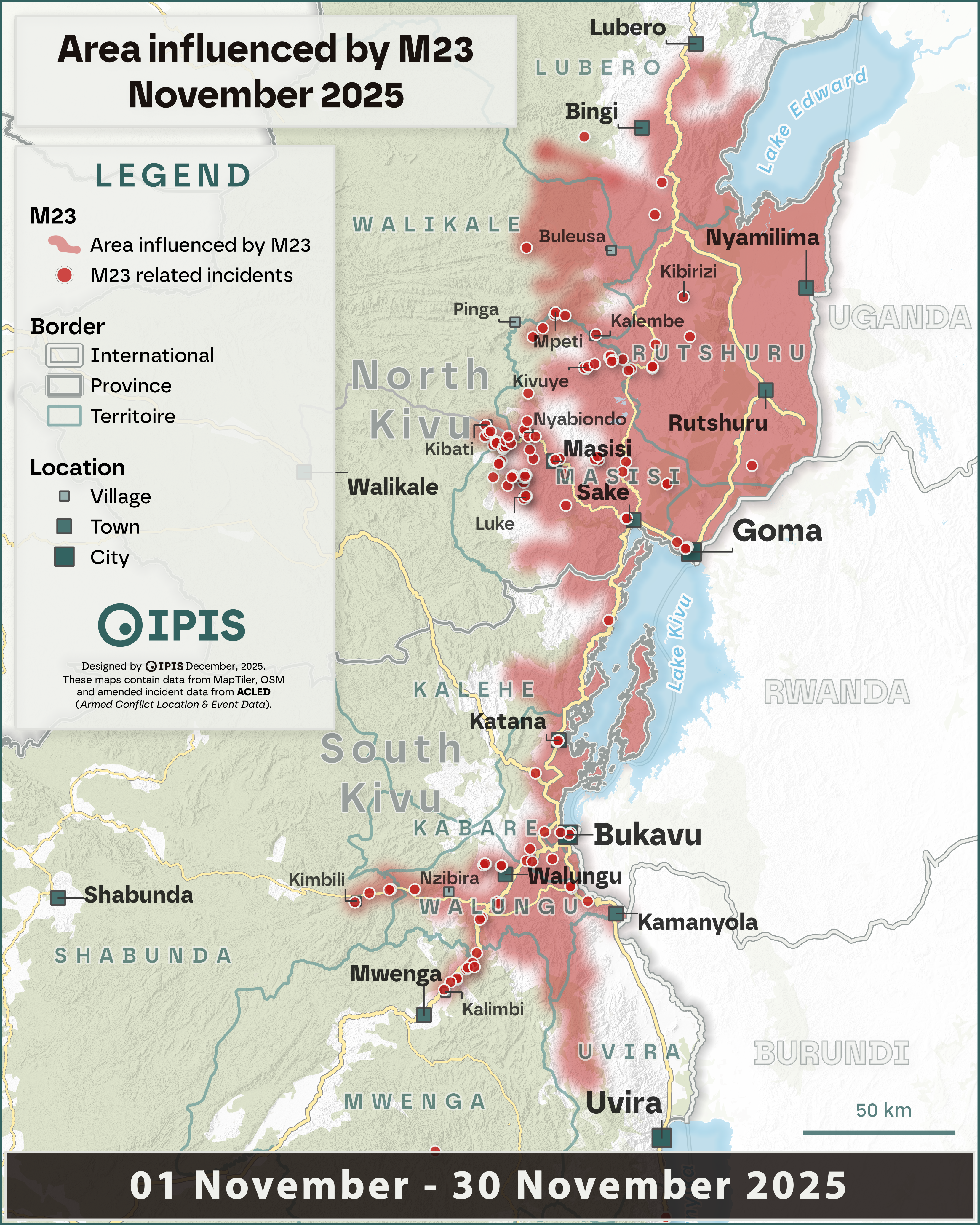

On 4 December 2025, Rwanda and the Democratic Republic of the Congo (DRC) signed the US-brokered Washington Accords for Peace and Prosperity, committing to cease hostilities, establish a permanent ceasefire, and implement the 25 April Declaration of Principles and the 27 June Peace Agreement.
However, critical questions have been raised about the prospects for lasting peace in eastern DRC, as Kigali continues to deny its backing of the M23 despite documented UN evidence, and separate peace talks between the Congolese government and the AFC/M23, held in Qatar, have so far stalled following the signing of the Doha Framework of Comprehensive Peace on 15 November.
Consequently, there was little impact of the agreement on the ground, as fighting persisted in eastern DRC’s North and South Kivu provinces. In Kamanyola (Walungu territory, South Kivu), a strategic town in the tri-border area of the DRC, Rwanda and Burundi, intense clashes were even ongoing at the time of signing.
Also in the days following the Washington Accords, the AFC/M23 continues to seize new territories. On 10 December, its forces entered Uvira, South Kivu’s second-largest city and provisional provincial capital, further underscoring the disconnect between diplomatic developments and realities on the ground.
Collapsing ceasefire – The fall of Uvira

The latest AFC/M23 advance in South Kivu began on December 2, with three days of intense fighting between Rwandan-backed AFC/M23 and FARDC-aligned Wazalendo groups, supported by Burundian troops, in Kamanyola (Walungu territory, South Kivu) and neighbouring localities. Local residents indicate that two days prior to the Washington meeting, hundreds of soldiers crossed the border overnight to reinforce positions alongside the AFC/M23.
This was followed by a rapid AFC/M23 advance across the Ruzizi plain along the RN5 Bukavu-Uvira axis. The renewed violence in the region triggered a large-scale population displacement, with the UN estimating that approximately 200,000 people have been displaced since 2 December.
The Congolese army accused Rwanda of supporting the offensive through artillery shelling allegedly fired from Bugarama, on Rwandan territory. Rwandan media outlets denied the accusation, claiming, based on AFC/M23 statements, that the shelling originated from Burundian territory.
On 8 December, DRC President Félix Tshisekedi publicly condemned Kigali in an address to parliament, accusing Rwanda of violating the latest Washington peace agreement just one day after its signing.
“The Rwandan Defense Forces carried out heavy weapons attacks from the Rwandan town of Bugarama, causing heavy material damage and human casualties.”
(President Félix Tshisekedi, Radio Okapi 08/12/25– unofficial translation from French)
He further framed the ongoing conflict not as an internal rebellion or a civil war, but as a regional proxy conflict, stating:
“(…) “This is a proxy war of aggression aimed at challenging our sovereignty over a highly strategic area, rich in critical minerals and economic potential that is crucial to the future of our nation.”
(President Félix Tshisekedi, Radio Okapi 08/12/25– unofficial translation from French)
Two days later, on December 10, AFC/M23 forces entered the city of Uvira, encountering only limited resistance from Wazalendo, who had mostly withdrawn alongside FARDC from the town southwards in the direction of Swima, Makobola and Baraka (Fizi territoire, South Kivu).
Burundi drawn deeper into the crisis
As fighting intensified along the DRC-Burundi border, Burundi closed its border posts on 10 December 2025, declaring the main crossing points ‘military zones’ after M23 forces advanced toward Uvira. Burundi has previously deployed more than 10,000 troops in the DRC, and reports indicate the active involvement of the Burundian National Defence Force (FDNB) in combat against the AFC/M23 in Mwenga and Uvira territory. The government in Gitega reportedly considers the fall of Uvira as an existential threat and further condemns the reports of bombs and crossfire reaching Burundian territory.
South Kivu’s frontlines shift westwards

Since October, AFC/M23 has also advanced into territories where it had previously been absent. AFC/M23 units entered Shabunda territory west of the mineral-trading hub of Nzibira (Walungu territory), moving through the forests of Kahuzi-Biega National Park. By mid-November, the rebel group had reportedly seized the first villages in Shabunda territory along the RP503.
Shortly thereafter, AFC/M23 forces advanced rapidly in the Mwenga territory (South Kivu), capturing several villages along the RN2. This advance forced the FARDC / Wazalendo coalition and Burundian soldiers (deployed in Mwenga territory) to withdraw their positions. Reports surfaced of deserting FARDC / Wazalendo soldiers looting civilian property during their retreat. As of late November, the advance stalled in Kalambi (Mwenga territory, South Kivu), less than 10km away from Mwenga town.
In November, FARDC conducted airstrikes on M23 positions and economic infrastructure in South Kivu, specifically targeting the Karembu gold-mining zone near Bawahungu (Ngweshe, Walungu Territory, South Kivu). After these attacks, reports surfaced of Chinese nationals being engaged in semi-industrial gold mining at this site in collaboration with the M23.
This marks the second offensive on M23-controlled mining sites in South Kivu, after the FARDC had carried out drone strikes in October on the Twangiza mine (Luwindja, Mwenga territory), which destroyed its power infrastructure and led to a suspension of mining operations. The Chinese-owned Twangiza Mining company (formerly BANRO), claims that the M23 looted approximately $70 million worth of gold from this mining site since May 2025. In early May, M23 forces had captured Luciga near the Twangiza mine, making it the first industrial gold mine under their control.
North Kivu – sustained violence, limited territorial change

In M23-controlled areas and along the frontlines in North Kivu, clashes between FARDC/Wazalendo and AFC/M23 continue, with minimal change to territorial positions.
In Masisi territory, the siege of the strategic town of Pinga persisted throughout October and November, with clashes along the Mpeti-Pinga and Nyabiondo-Pinga axis.
The frontlines have stalled in the Osso chiefdom (Masisi territory), where continuous clashes between the M23 and FARDC/Wazalendo have occurred since July. Although the M23 were able to seize new villages in the Nyamaboko groupement west of Masisi town (Masisi territory, North Kivu), territorial control remains highly contested in the area. Despite ongoing intense fighting in these areas west of Masisi town, the M23 issued evacuation orders to 2,000 displaced households who had sought refuge in Masisi’s capital. They are forced to return to their villages of origin, often in unstable areas of Masisi territory.
This coincides with new cholera outbreaks reported in the Masisi health zone since early October. Humanitarian workers believe that this outbreak may have motivated the M23’s evacuation orders. There is growing concern that the health crisis will deteriorate further, as returning to villages in the frontline will prevent access to proper sanitation and clean drinking water.
Meanwhile, the M23 continues to exploit the local population for military logistics and forced recruitment, and is accused by Wazalendo groups of using civilians as ‘human shields’. In the western Rutshuru territory, reports of arbitrary rapes and killings persist, particularly in the Bwito chiefdom. Here, violence against civilians continues to escalate, driven by M23’s reprisal operations, accusing civilians of being affiliated with Wazalendo or FDLR.
Further reading
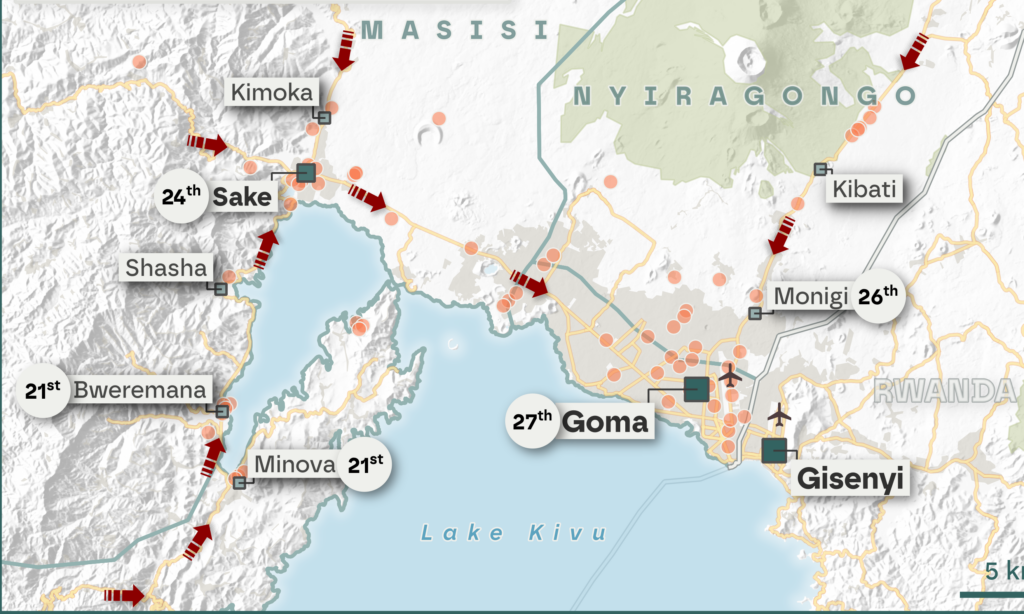
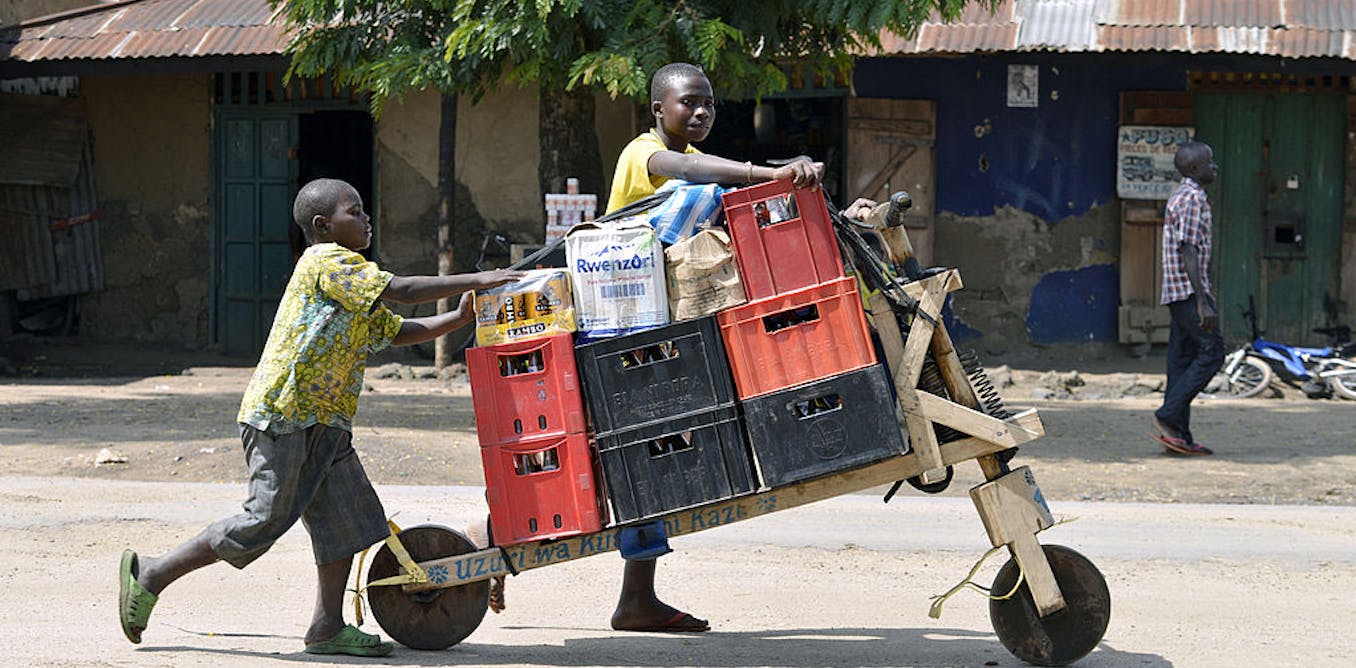
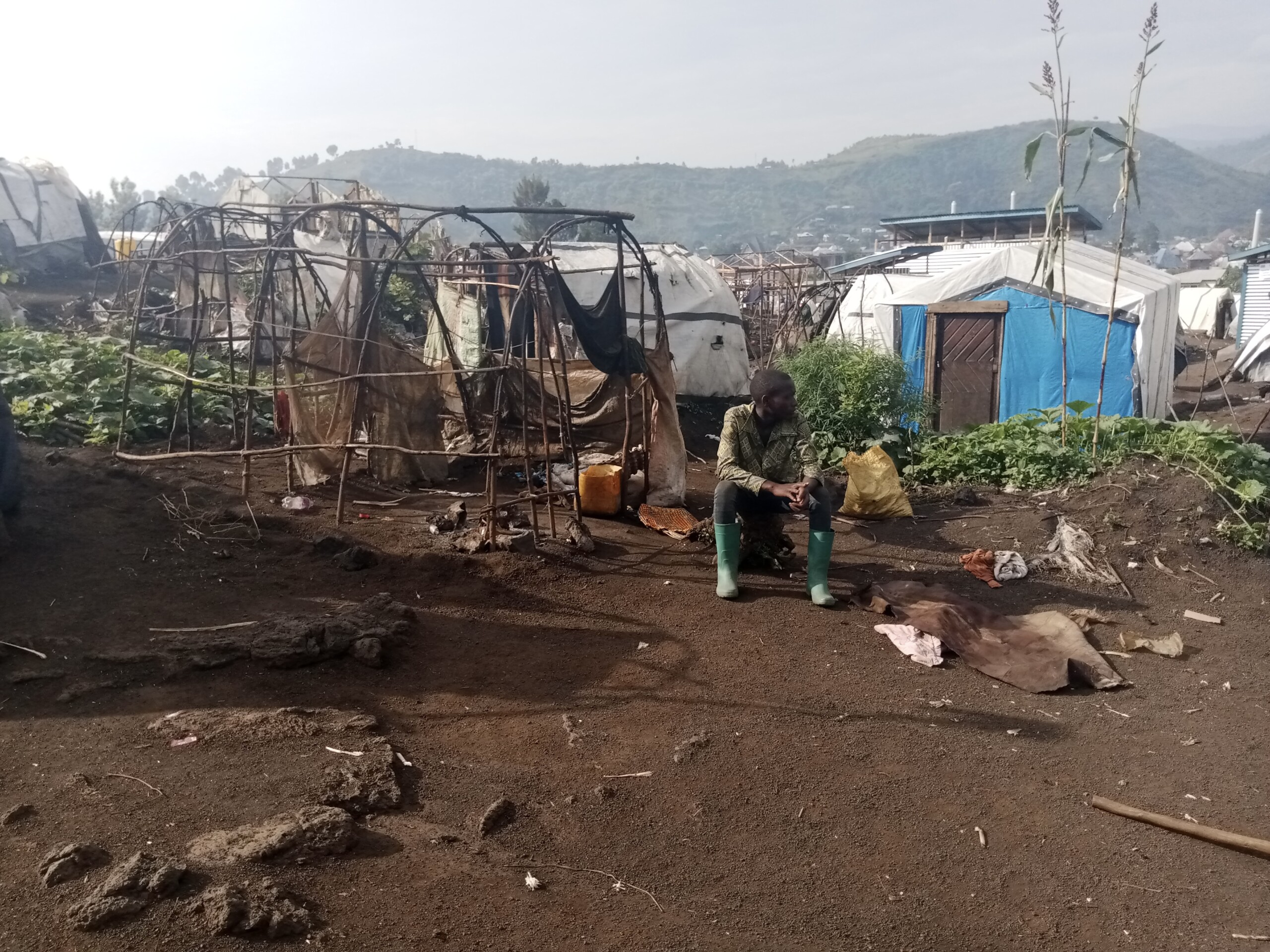
All M23-related maps designed by IPIS


This publication has been produced with the financial assistance of the Belgian Directorate-General for Development Cooperation and Humanitarian Aid (DGD). The contents of this publication are the sole responsibility of IPIS and can under no circumstances be regarded as reflecting the position of the Belgian Development Cooperation.