
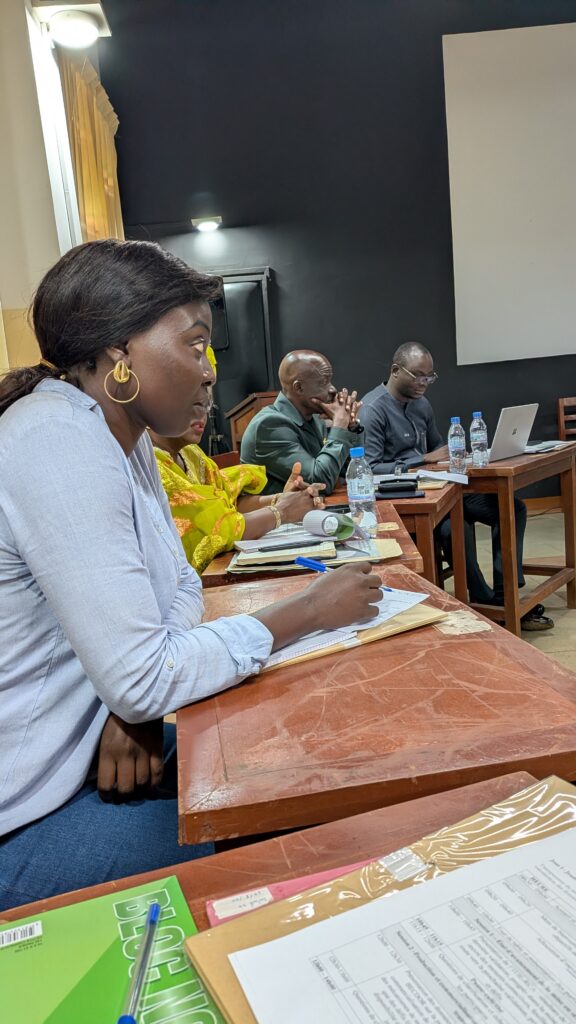
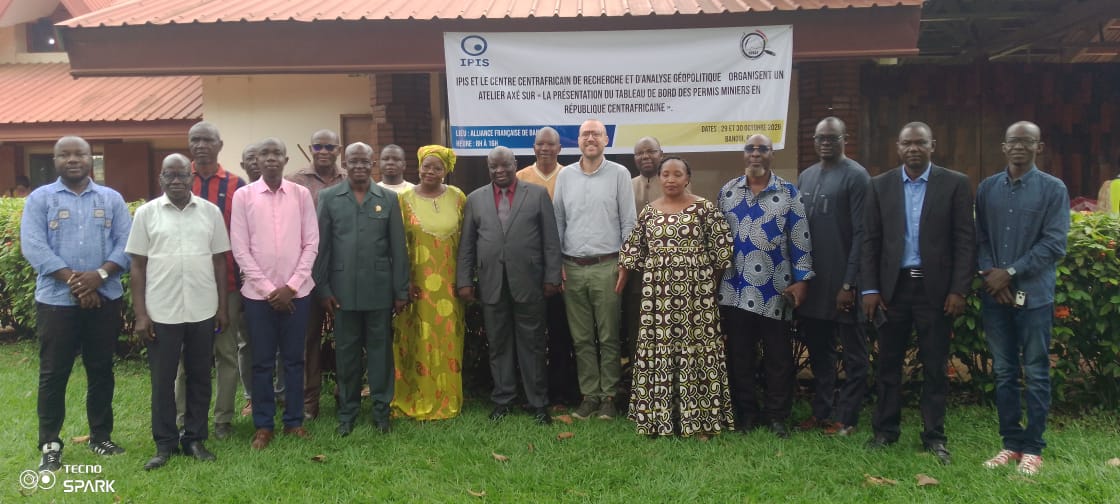
On 29–30 October 2026, IPIS and the Centre Centrafricain de Recherche et d’Analyse Géopolitique (CCRAG) organised a workshop on mining sector transparency and governance in Bangui, Central African Republic (CAR). Participants included representatives of government institutions, notably the national secretariat of the Extractive Industries Transparency Initiative (EITI) in CAR (ITIE-RCA) and the newly established Secrétariat Permanent de Certification des Substances Minérales (SPCM), local authorities and elected representatives, civil society organisations, researchers and representatives of women artisanal miners.
Discussions addressed progress in strengthening transparency and accountability following CAR’s temporary suspension from EITI in November 2024. IPIS also presented its new interactive dashboard, which makes information on mining permits and companies more accessible. Other discussions examined developments in the gold and diamond sectors, growing interest in critical minerals, and persistent governance, safety and environmental challenges in mining areas.
Participants particularly welcomed the open exchanges between government representatives and civil society, with several describing the workshop as a first-of-its-kind initiative bringing these actors together for frank and constructive dialogue that connects national policy discussions with realities in mining areas. Sensitive issues, including corruption, illicit mineral trade and foreign involvement in mining, were openly addressed. The exchanges highlighted both the challenges facing CAR’s mining sector and opportunities for stronger cooperation to improve transparency, oversight and accountability.
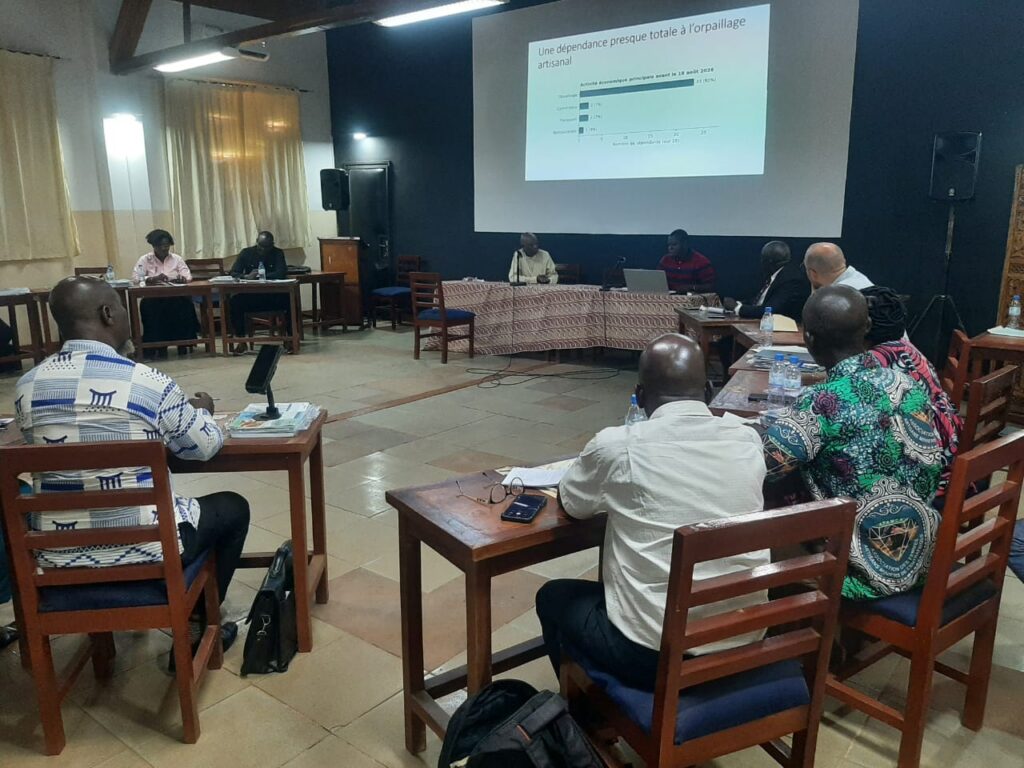
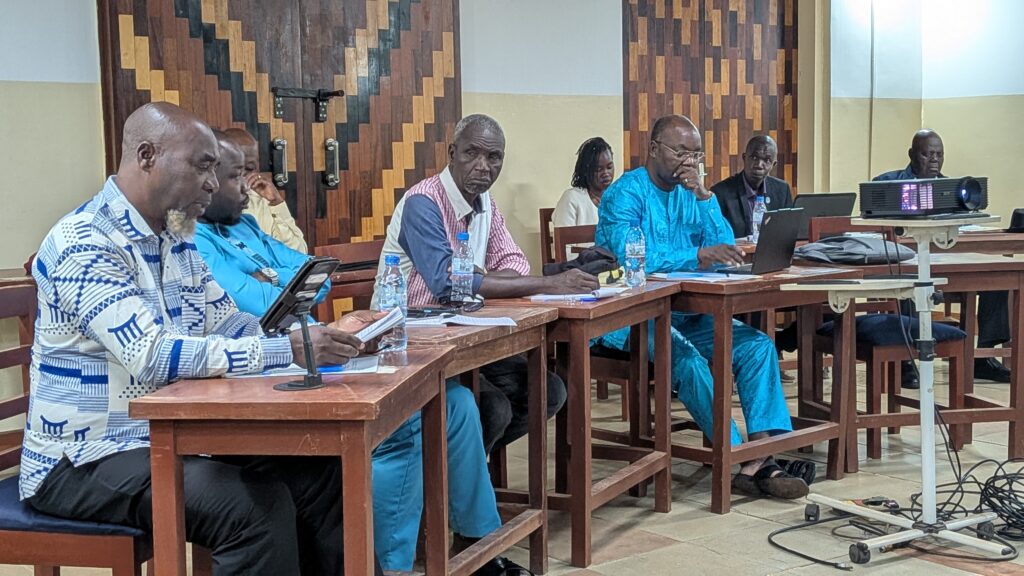
Progress and remaining challenges in EITI implementation
The first day focused on extractive sector transparency, with ITIE-RCA presenting its roadmap for addressing the shortcomings that led to CAR’s EITI suspension in 2024.
An important achievement has been the development of a new ITIE-RCA website, providing easier access to a growing collection of official mining documents, reports and licensing information. ITIE-RCA has also organised capacity-building activities for civil society and media representatives, while a consultant has been engaged to develop a beneficial ownership register. Work is continuing to improve contract disclosure and the reliability and completeness of extractive sector data.
However, significant challenges remain. Discussions highlighted difficulties in obtaining required data from government departments and private sector actors, particularly on production, revenues and contractual arrangements. Sensitive issues include the transparency of mining-related agreements involving Russian-linked security interests and Rwandan security and investment partnerships. Illegal mining activities by foreign operators, including some Chinese players, and the reported use of artisanal mining cooperatives as fronts to circumvent regulatory requirements create additional challenges for oversight and reporting.
Strengthening meaningful civil society participation emerged as another priority. Recent training activities by ITIE-RCA represent encouraging progress, but years of insecurity, limited funding and pressures on civic space have weakened independent civil society engagement in the mining sector. Discussions highlighted the need for continued capacity-building on regulatory frameworks and sector developments, alongside efforts to rebuild networks with mining communities and grassroots organisations, strengthen monitoring capacities and restore information flows between mining areas and national-level advocacy.
Sustained efforts by the relevant government institutions will be needed to demonstrate sufficient progress before CAR’s next EITI Validation in April 2028. Failure to address the outstanding shortcomings could prolong the country’s suspension or ultimately lead to delisting from EITI, making it even more difficult to attract responsible investment and secure support from international partners.
Improving public access to mining permit information
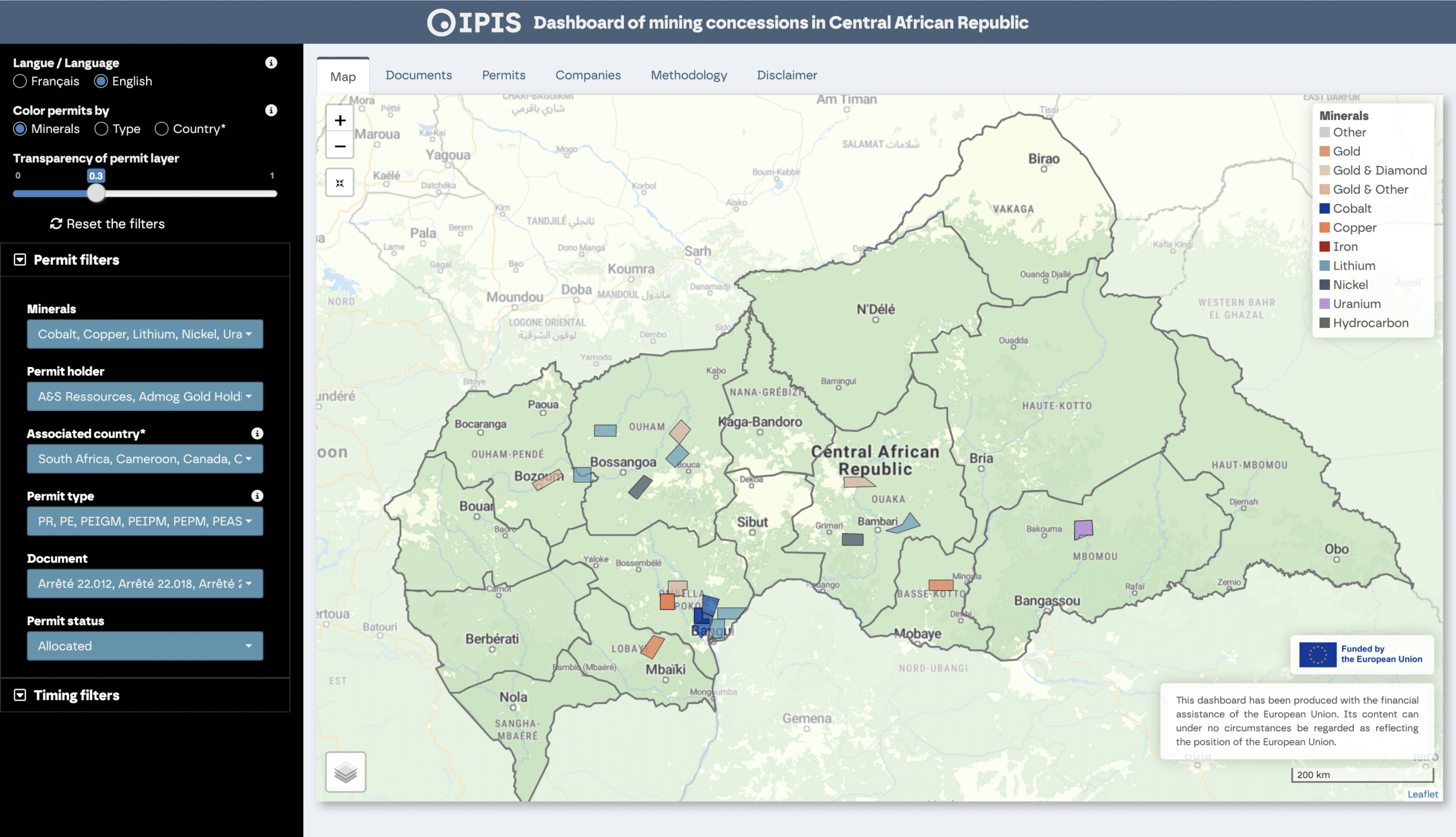
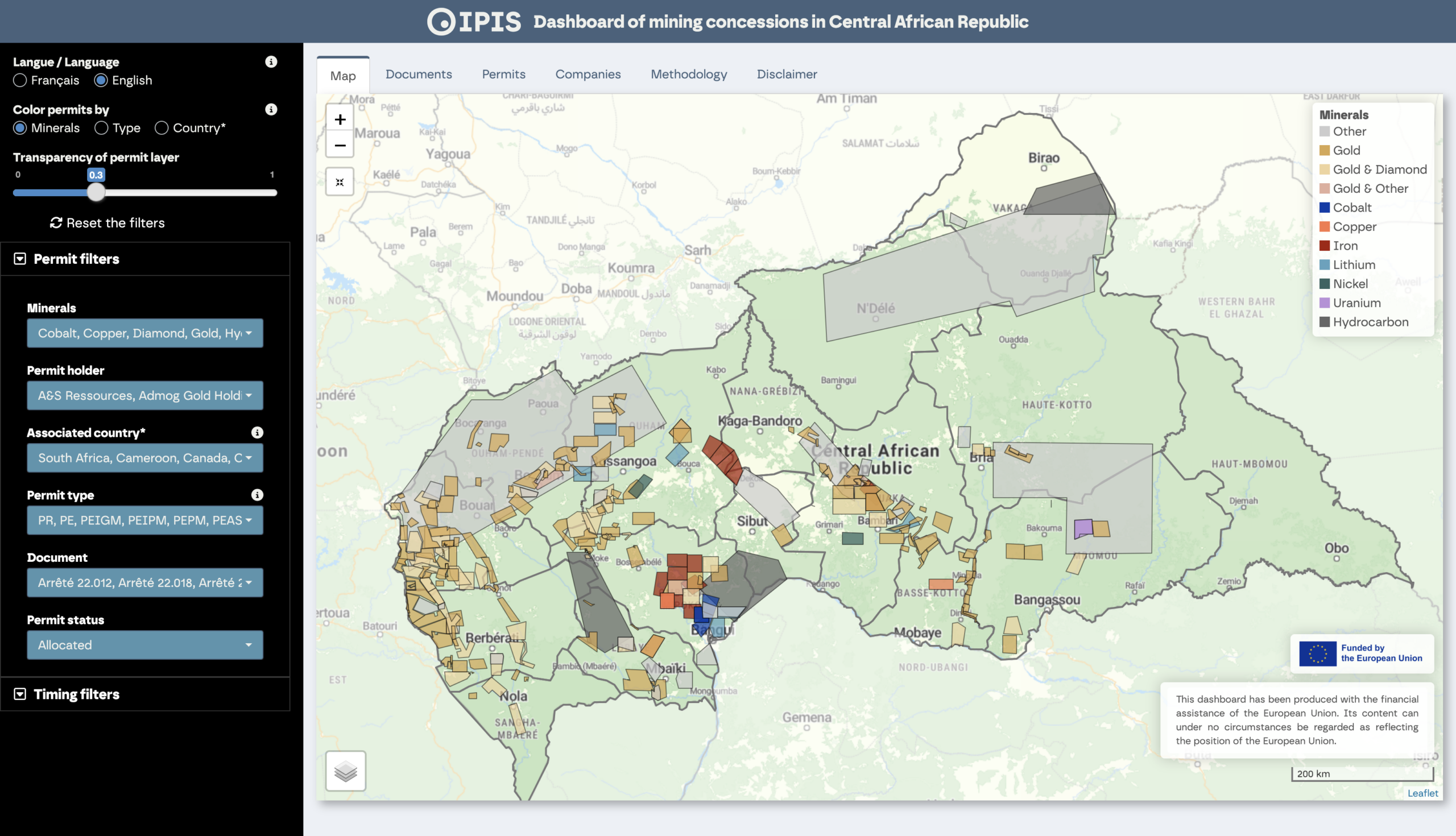
A central part of the workshop was the presentation of IPIS’s interactive mining permits dashboard, developed with financial support from the European Union.
Building substantially on official documents published by ITIE-RCA, the dashboard maps mining licences, companies and their representatives, complemented by open-source research on their backgrounds and possible links to foreign interests. IPIS demonstrated how users can explore the interactive map, filter information by mineral or permit type, and analyse broader trends as well as details of individual permits and their holders.
Discussions also touched upon growing interest in CAR’s critical and strategic minerals. IPIS’s dashboard identifies around 20 large-scale exploration permits issued since 2021 for minerals including lithium, cobalt, nickel, copper and uranium. Yet participants noted that little is publicly known about many of the companies holding these permits, their exploration activities and investment plans, or the commercial potential of the deposits concerned.
ITIE-RCA representatives warmly welcomed the dashboard, recognising it as an important contribution to transparency and a concrete example of how progress in EITI implementation can support further independent analysis and public awareness. Participants agreed that the tool can help governmental actors, civil society organisations, media and other stakeholders conduct more informed, evidence-based monitoring and advocacy.
Participants also considered how the dashboard could be further developed to respond to the interests and information needs of different stakeholders in CAR. Suggestions included incorporating information on companies’ fiscal contributions and community development commitments, identifying overlaps between mining permits and protected areas or forest reserves, and using remote sensing data to compare officially granted licences with actual developments on the ground.
New opportunities and uncertainties for CAR’s diamond and gold sectors
The second day began with a discussion of developments in mineral production and trade following the lifting of the remaining Kimberley Process (KP) restrictions on rough diamond exports from CAR in November 2024.
Paradoxically, the lifting of the embargo has not produced a recovery in official diamond exports. According to figures presented during the workshop, exports declined by 36.4% in volume and 40.5% in value in 2025 compared with 2024, against the backdrop of the international natural diamond market crisis. Production from formerly restricted eastern areas accounted for just 2.3% of reported production. Trade also remains highly concentrated, with one company reportedly accounting for 93% of diamond exports. Participants raised concerns about continued smuggling, including estimates that most larger, high-value diamonds leave the country illegally.
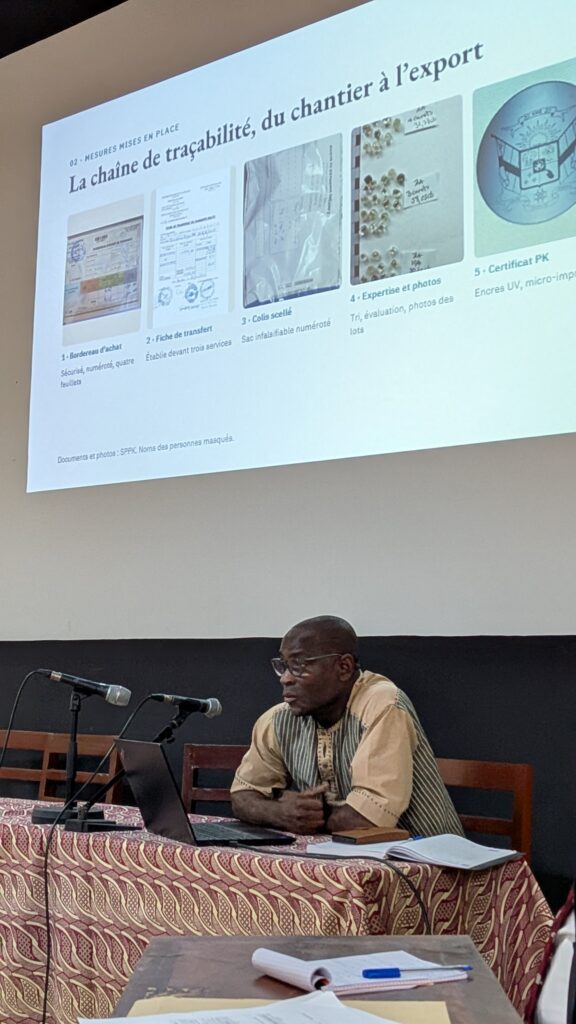
Years of restrictions on diamond trading, compounded by the current market crisis, have encouraged many artisanal miners to shift towards gold. This is reflected in the rapid growth of officially recorded gold volumes, which increased by approximately 670% to 4.39 tonnes in 2025. However, the systems for monitoring and certifying mineral production and trade have not yet adapted to this shift. An important institutional reform is therefore the transformation of the former KP Permanent Secretariat (SPPK) into the Secrétariat Permanent de Certification des Substances Minérales (SPCM), extending its mandate from diamonds to gold. Still in its early stages, the reform aims to strengthen gold certification and traceability.
Discussions also highlighted uncertainties surrounding the implementation of the new 2024 Mining Code, particularly while key implementing regulations remain pending. Concerns included the future of independent mineral traders (collecteurs), whose activities will be restricted under the new framework, and mining cooperatives, which will no longer be authorised to export minerals directly. While intended to strengthen oversight and combat fraud, these reforms could disrupt established trading and financing arrangements if not accompanied by practical measures to help existing actors adapt.
Connecting national reforms to realities in mining areas
Representatives of civil society and local authorities, including from Boda and Bouar, shared experiences of environmental damage linked to gold mining, including mercury and cyanide use, riverbed exploitation and ecosystem destruction. Insecurity and banditry further complicate artisanal miners’ livelihoods and the sector’s contribution to local development.
Discussions also openly addressed fraud and corruption in the mining sector, with participants acknowledging that public officials are frequently exposed to corruption risks. Important efforts are underway to strengthen enforcement, including the deployment and training of specialised mining police units. However, progress on broader reforms has been slow. A draft strategy to combat mineral fraud and smuggling, developed following a high-level regional workshop in Yaoundé in 2021, includes proposals for a multi-agency task force to improve coordination between government services and with neighbouring countries, particularly Cameroon. Several years later, the strategy is still awaiting political approval.
Lessons from the Zamboye mining tragedy
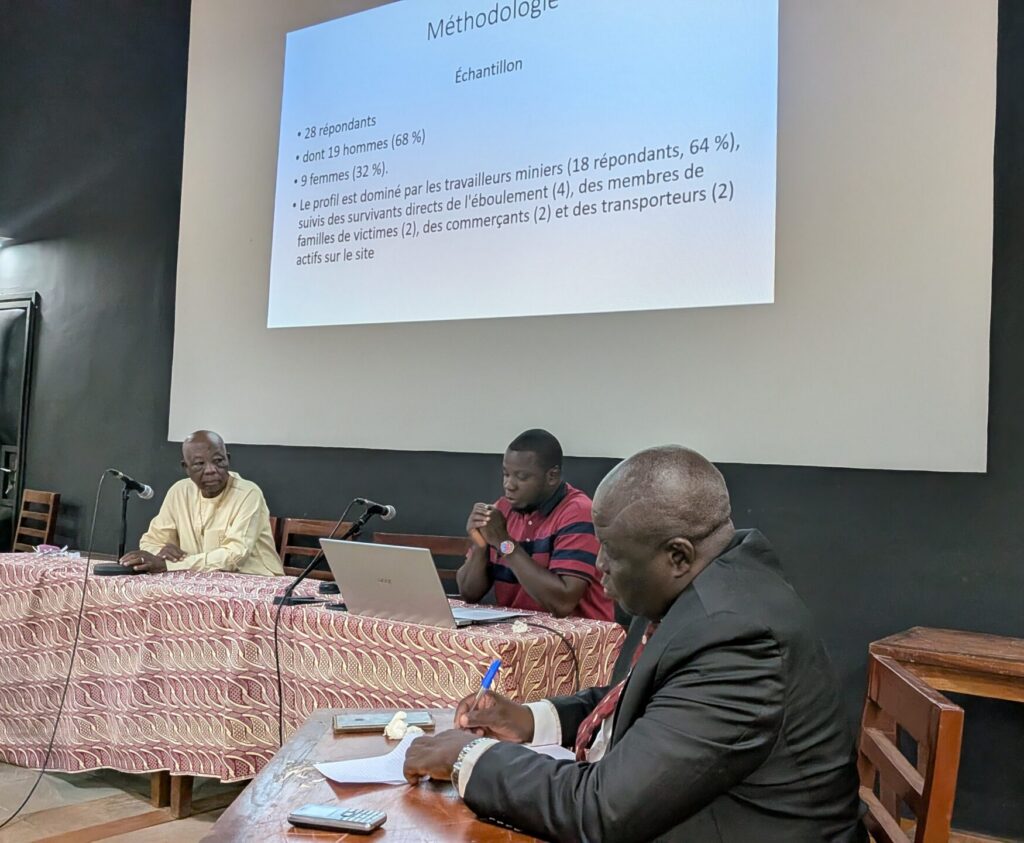
A particularly sobering discussion concerned the deadly collapse at the artisanal gold mining site of Zamboye, near the Cameroon border, on 18 August 2026. While the government reported 49 fatalities, local sources and humanitarian workers put the death toll at more than 100.
CCRAG presented the findings of a joint fact-finding mission conducted with the Cameroonian organisation RELUFA following the accident, highlighting broader challenges related to mining safety, site management and oversight.
Although exceptional in scale, the tragedy reflects wider safety risks in artisanal mining. Discussions emphasised the importance of preventive inspections, technical assistance, training and closer cooperation with mining communities. Participants also highlighted the limitations of relying primarily on mine closures or sanctions. Where mining provides essential livelihoods, improving safety requires supporting miners in adopting safer practices while addressing the practical constraints they face.
Without stronger support and oversight, participants warned, similar tragedies are likely to occur again.
Building on transparency and constructive dialogue
The workshop underscored that transparency requires more than publishing information. Reliable and accessible data must support informed debate, independent monitoring and meaningful participation by communities affected by mining.
Building on the discussions, IPIS and CCRAG will explore opportunities for further cooperation with national institutions, civil society organisations and international partners to strengthen the use of publicly available mining data, further develop the mining permits dashboard, and support civil society monitoring and policy engagement.

This workshop was organised with the financial support of the European Union. Views expressed can not be considered as representing the position of the European Union.