
The Allied Democratic Forces (ADF) was considered the deadliest armed group operating in eastern DRC in 2024, responsible for 38% of all conflict-related deaths in Ituri and North Kivu provinces. Created in 1995 from a merger between Uganda’s Tabligh movement and remnants of the National Army for the Liberation of Uganda (NALU) with the objective of overthrowing the Ugandan government, it has over time gradually redefined itself. Following sustained military offensives by Ugandan, Congolese and MONUSCO troops, and the 2015 arrest of its leader Jamil Mukulu in Tanzania, the ADF appeared on the “brink of extermination”, and regrouped under the new leadership of Seka Musa Baluku. Baluku reoriented the ADF towards the global Salafi-jihadist movement, adopting an Islamist and jihadist rhetoric, to secure support and funding. In 2019, the ADF was publicly recognised by the Islamic State (IS) as part of its Central Africa Province (ISCAP) and subsequently designated as a terrorist organisation by the United States and United Nations.
This briefing argues that while the ADF has adopted jihadist rhetoric and maintains a real (though limited) relationship with IS, the dominance of the “ISCAP” label is analytically distorting and operationally counterproductive. The “global jihad” frame amplifies ideological and transnational dimensions while pushing the local political economy of violence and borderland dynamics into the background. Research on the ADF demonstrates that ADF violence is multilayered, shaped by ideological, military, political and economic logics that often intersect. It also legitimises heavily militarised counterterrorism responses that have repeatedly failed to protect civilians (often even exacerbating insecurity) and avoid confronting state predation, corruption, and marginalisation, the structural conditions that sustain recruitment and violence. Understanding how and why the IS label has become dominant, and who benefits from it, is therefore essential to reassessing current policy approaches.
The political utility of the ‘Islamic State Central Africa Province’ label
Labels such as “terrorist organisation” shape which actors are considered legitimate interlocutors, what measures are deemed acceptable, and which kinds of violence become visible. Drawing on securitisation theory, the designation of the ADF as an IS affiliate functions as a securitising move that legitimises exceptional measures. The question is therefore not only whether the ADF is an IS affiliate, but who gains from insisting that it is. This framing has been instrumentalised by multiple actors, most consistently and effectively the Ugandan state.
Ugandan authorities have long portrayed the ADF as an existential terrorist threat, at times alleging links to Al-Qaeda and Al-Shabab—claims repeatedly contested by the UN Group of Experts on the DRC. The ADF’s formal association with IS has since bolstered Uganda’s narrative. Domestically, this construction serves regime-security priorities by justifying militarisation and deflecting allegations of torture by Ugandan security forces. Internationally, it has positioned Kampala as a key partner in the US-led “war on terror”, facilitating access to military training, equipment and financial assistance. Regionally, the ISCAP label has provided political cover for repeated military interventions in the DRC, including the 1998 invasion. These deployments intersect with longstanding economic and geopolitical interests: eastern DRC constitutes a crucial market for Ugandan products, access to gold, and a buffer to protect Uganda’s oil installations. Observers thus argue that Operation Shujaa, a joint military offensive by Ugandan and Congolese forces launched in 2021 against the ADF, is not purely a counterterrorism operation, noting that Ugandan military operations have been concentrated in gold-rich areas of Ituri, Beni and Lubero—areas it considers within its zone of influence— and along Ugandan-financed road corridors. The IS label therefore functions as a securitising device that provides an impetus for a deeper and more durable Ugandan presence in eastern DRC.
For IS, recognition of the ADF must be read against the backdrop of territorial losses in Syria and Iraq in 2019. Anticipating defeat, IS leadership sought to transition back to insurgency while maintaining a global narrative of resilience and expansion through the proclamation of new “provinces”. The ADF, operating in remote areas with no significant local Muslim populations, offered few operational benefits but significant symbolic value. By accepting Baluku’s pledge and incorporating ADF operations into its propaganda, IS could demonstrate geographical expansion, sustain its brand, and signal that its struggle continued. Finally, for the ADF itself, IS recognition is a “badge of honour” that elevated its importance within the regional conflict landscape. It appears to have facilitated access to training, financial and logistical support, reflected in the increased use of improvised explosive devices, suicide bombings, and drones. Crucially, rather than seeking legitimacy through governance or community support, the ADF generates external legitimacy vis-à-vis IS Central by demonstrating operational capacity and ideological commitment through high-profile violence against civilians. The relationship has therefore been less about command and control than about mutual reputational benefits.
What the ISCAP label obscures
While the “ISCAP” label is not wholly inaccurate, certain ADF members genuinely espouse transnational jihadist ideas, and communities in the Beni region experience ADF violence as terror in a literal sense, foregrounding the group’s IS affiliation as the primary frame of analysis obscures the other drivers of violence.
- Embeddedness in borderland political and conflict networks
The ADF is deeply embedded in the political and economic networks of the Uganda-DRC borderlands, which, as Scorgie-Porter notes, explains its resilience and practices. These are characterised by weak state presence, overlapping power struggles, land disputes, ethno-regional competition, and contests over natural resources. The ADF has become integral to this war-economy system, interacting with civilians through a mix of fear, patronage, ethnic linkages, and the manipulation of local grievances. It has targeted disenfranchised borderland populations such as the Bakonjo and Nande to secure acquiescence or support. Communities engage with the group pragmatically, balancing fear, coercion, and survival rather than ideological affinity. Its resilience is thus less a function of global jihadist mobilisation than of its ability to operate and exploit these borderland dynamics. The ISCAP label flattens this embeddedness and recasts a locally entangled armed actor as an externally driven terrorist threat.

- Recruitment beyond ideology
The ISCAP frame assumes recruitment driven primarily by ideological radicalisation. However, the evidence suggests otherwise. ADF recruitment relies on three main methods: forced conscription, deception, and voluntary recruitment through propaganda and co-option. They exploit structural marginalisation, unemployment, and the lack of access to education in both Uganda and the DRC, with many individuals reporting they were lured by false promises of protection, income, or land. Only a minority appears to have been primarily motivated by religious conviction. In areas where the ADF has maintained a relatively stable presence, cooperation with the group reflects a pragmatic survival strategy shaped by income possibilities and the threat of retaliation.
- State complicity and military fragmentation
The terrorism frame tends to presume a relatively clear perpetrator-victim distinction. However, ADF violence exists within a fragmented security landscape characterised by collusion, selective passivity and opportunistic behaviour among both state and non-state actors. Various reports have pointed to internal complicity within the Congolese army (FARDC), ranging from passivity to open collaboration, as a key enabling factor. Fahey and Verweijen have warned against the systemic attribution of almost all massacres in the Beni region to the ADF, as there is compelling evidence that other armed groups and elements within the Congolese security forces are also implicated, often imitating ADF-style violence to conceal their own actions. Exclusive blame placed on the ADF obscures the multiplicity of actors implicated in violence and enables impunity for state and non-state perpetrators alike. In this sense, the ISCAP label distorts the character of the violence, shifting attention away from governance failures and internal military fragmentation; and reshapes which forms of violence become visible, investigable, and politically actionable.
The dominance of the ISCAP frame has produced operationally counterproductive responses that have repeatedly failed to contain the ADF, and in several respects, exacerbated insecurity. Military pressure on ADF strongholds resulted in the group dispersing into new weakly governed areas such as north-western Lubero, Mambasa and Irumu, where it regrouped and terrorised civilians into fleeing. These movements are strategic rather than ideological, enabling the group to expand its territorial reach, resupply, secure new camps, and divert UPDF/FARDC attention. As such, by 2024, the ADF had become the armed group responsible for the highest number of civilian killings in the DRC. Furthermore, the heavy reliance on military solutions has overly empowered the FARDC and auxiliary armed groups (including local self-defence militias and Wazalendo), despite their well-documented records of abuses and violence, blurring the boundary between state and non-state violence, and undermining civilian protection and long-term stability. This securitised delegation of force has obscured the role of other armed actors and local elites in sustaining violence, racketeering and predation.
More broadly, the ADF should be understood as one element of a wider conflict ecosystem rather than an external terrorist threat that can be “removed” through force alone. Area experts have repeatedly warned that emphasising the IS label privileges military responses over dialogue, reduces incentives for defection, and sidelines demobilisation and reintegration programmes. As long as the structural conditions that facilitate recruitment and violence, such as state predation, insecurity, corruption, and the marginalisation of borderland communities, remain unaddressed, military pressure alone is unlikely to produce lasting change. Crises in such contexts are not sudden deviations from “normality” but involve continuities and transformations within the existing social and political orders. Therefore, effective responses require shifting away from externally imposed counterterrorism templates toward approaches grounded in local realities. This includes engaging with informal and customary authorities, addressing land and resource disputes, curbing security force abuses, and restoring credible forms of state protection and governance in borderland areas.
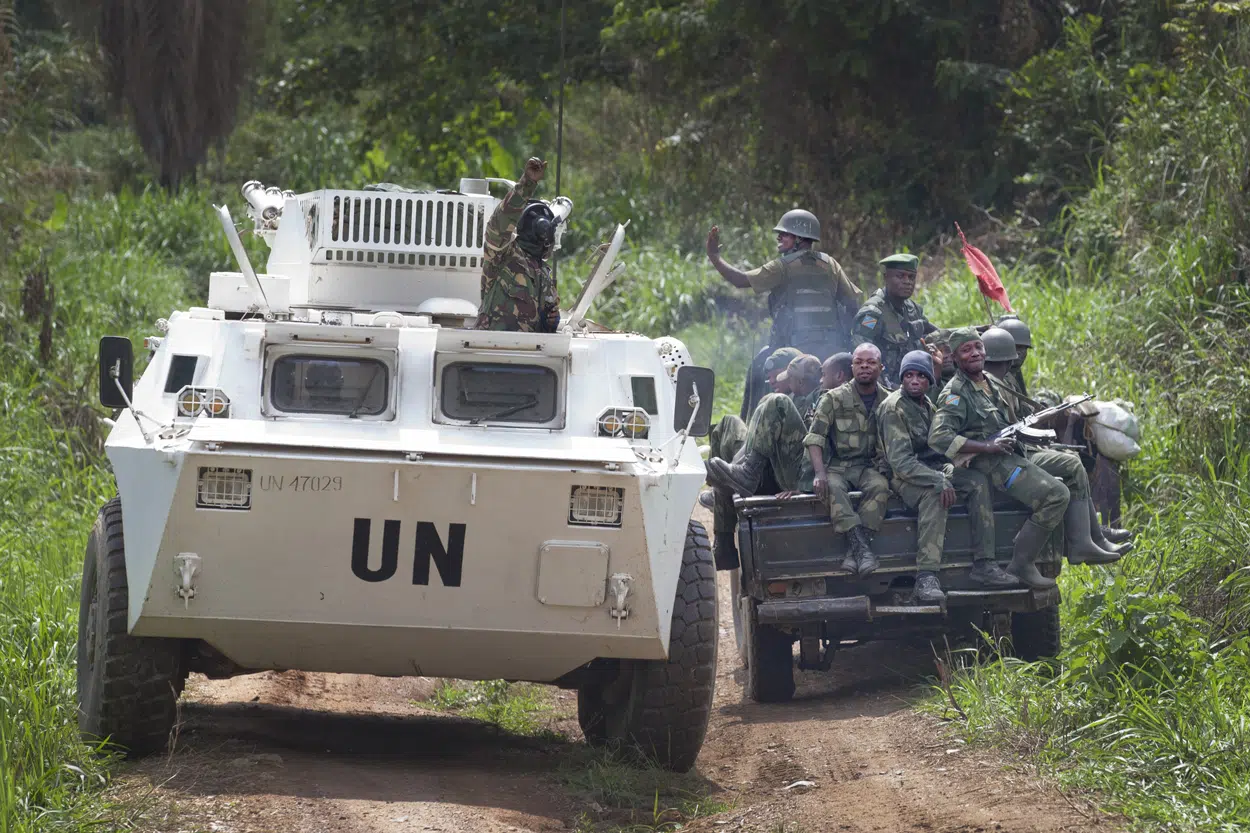
Photo: Senior MONUSCO officers and FARDC Forces visit Mwalika valley, a former ADF stronghold. ©MONUSCO. August 2021
Further reading


This briefing was produced with the financial assistance of the European Union. The contents of the editorial is the sole responsibility of IPIS and can under no circumstances be regarded as reflecting the position of the European Union.