
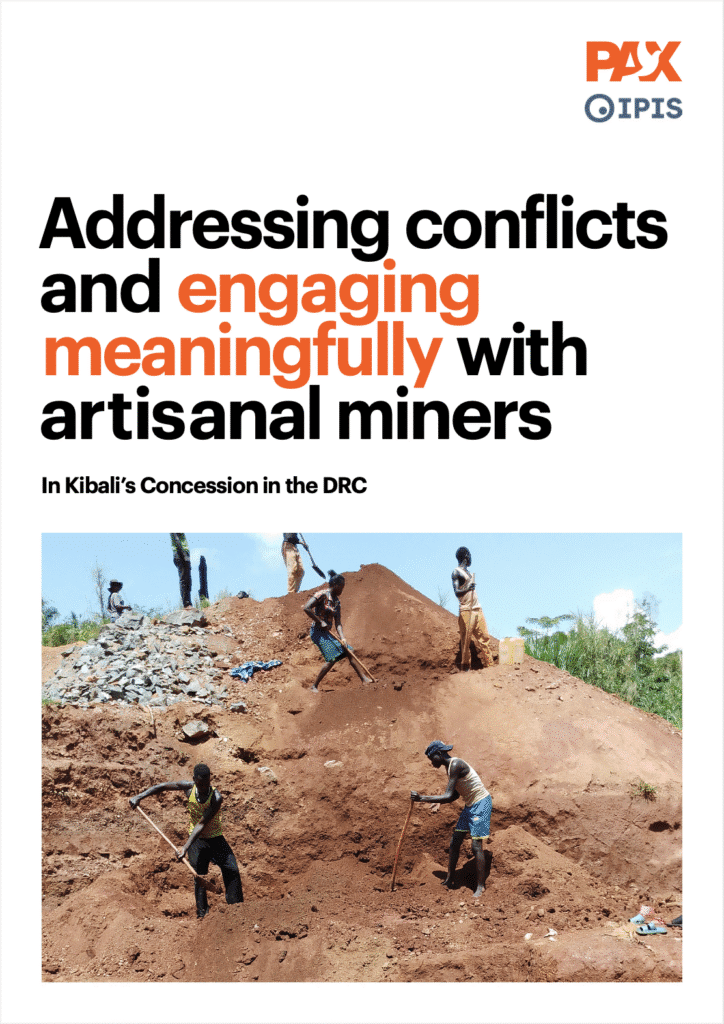
In the Faradje administrative territory in the northeastern Democratic Republic of Congo’s Haut-Uélé province, more than 5,000 people rely on artisanal gold mining to earn a living and support their families. Many artisanal-mining families have done so for generations. They currently work on sites that now fall largely within mining permits owned by Kibali Goldmines (Kibali), a joint venture of Barrick Mining Corporation, AngloGold Ashanti, and the Congolese parastatal Société minière de Kilo-Moto (SOKIMO). Community members have long criticized the lack of dialogue with both the company and the Congolese authorities.

Since 2014, the Congolese government has periodically attempted to halt artisanal mining within the Kibali concession in Faradje, without offering meaningful assistance to help miners transition to alternative livelihoods. In several instances, security forces have used excessive force in efforts to clear these sites.
The Dutch peace organization PAX has long been active in the Haut-Uélé province, working on conflict prevention and the protection of human rights. This includes work related to the Kibali gold mine. Since 2024, PAX and IPIS have collaborated to research and develop recommendations on the situation of artisanal miners within Kibali’s concession, focusing on Faradje territory. Together, we produced two complementary reports.
The first report, a factsheet led by IPIS, provides an overview of the findings of the mapping of the main artisanal gold mining sites within the Kibali concession in Faradje. It is based on extensive field research through interviews with a range of stakeholders in the artisanal mining sector, including miners, site managers, local authorities, civil society representatives, and administrative services at mining sites and nearby villages.

The report highlights several key issues:
- IPIS estimates that nearly 5,500 artisanal miners work at these mining sites.
- Artisanal gold mining is a vital source of livelihood in the region, and the gradual expansion of the Kibali gold mine has fueled tensions with artisanal miners, many of whom fear mass evictions and loss of income.
- Tensions intensified after several mine pits were backfilled, for which artisanal miners blamed Kibali.
- A lack of effective state oversight and precarious working conditions faced by artisanal miners.
- Elements of the Congolese army have been accused of misconduct and illegal interference in the mining sector, leading to negative perceptions among the local population. Allegations include the suppression of miners’ resistance to pit backfilling, illegal taxation, and opaque collaboration with Chinese semi-industrial companies.
PAX’s advocacy report “Addressing Conflicts and Engaging Meaningfully with Artisanal Miners in Kibali’s Concession in the DRC”, seeks to encourage more constructive engagement by Kibali with local mining communities, outline steps to avoid and minimize impacts on artisanal miners, and promote the resolution of longstanding grievances stemming from inadequate engagement in the past. Such measures could help bring about a more dignified future for these communities.
PAX formulated the following general recommendations to Barrick:
- supporting sustainable artisanal miners in the vicinity of the Kibali mine by creating ZEAs or subcontracting artisanal miners;
- promoting the employment of former artisanal miners at the Kibali mine;
- establishing alternative livelihood programs for former artisanal miners;
- supporting the voluntary return of migrant miners to their place of origin, if safe.
Kibali Goldmines’ response to the reports can be found in Annex.
Annex: Kibali Goldmines’ response

This publication has been produced with the financial assistance of the Belgian Directorate-General for Development Cooperation and Humanitarian Aid (DGD) and the Dutch Ministry of Foreign Affairs. The contents of this document can under no circumstances be regarded as reflecting the position of the Belgian Development Cooperation nor the Dutch Ministry of Foreign Affairs.