
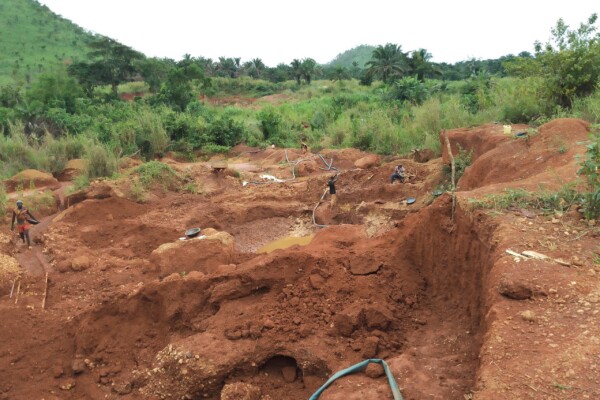
Mapping artisanal mining sites in the Kibali gold mine concession in Faradje territory, Haut-Uélé, DRC
December 8, 2025In the Faradje administrative territory in the northeastern Democratic Republic of Congo’s Haut-Uélé province, more than 5,000 people rely on artisanal gold mining to earn a living and support their families. Many artisanal-mining families have done so for generations. They currently work on sites that now fall largely within mining permits owned by Kibali Goldmines (Kibali), a joint venture of Ba
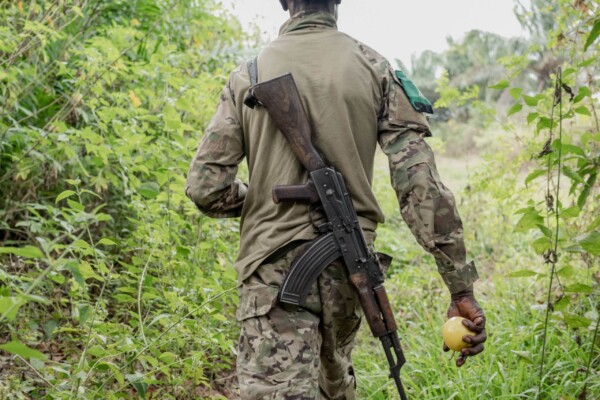
The weight of silence: How the Mobondo revolt is shaking western DRC
November 20, 2025Since 2022, western Democratic Republic of Congo (DRC) has been plagued by a major security and humanitarian crisis, with more than 5,000 dead, and 280,000 still displaced. While international attention has focused on the violent conflicts in eastern DRC, an intercommunity conflict at the on the outskirts of Kinshasa is sinking into a spiral of violence, with very little attention from national au

Addressing conflict hotspots in environmental degradation and resource governance: The role of EU due diligence frameworks
October 23, 2025The European Union has developed a set of due diligence frameworks aimed at improving corporate accountability in mineral supply chains, particularly those linked to conflict-affected and high-risk areas. These regulations, such as the Conflict Minerals Regulation, the Battery Regulation, and the Corporate Sustainability Due Diligence Directive (CSDDD), seek to address both social and environmenta

M23’s territorial advances in July, August, and September 2025 – Escalating violence and fragile peace in eastern DRC’s Kivu regions
October 17, 2025New peace agreements from Washington and Doha have brought hope for initiating a pathway to resolve the ongoing M23-conflict in DRC’s eastern territories in recent months. However, after the signing of the Declaration of Principles in Doha on 19 July, direct negotiations between the DRC and AFC/M23 were intended to result in a comprehensive peace agreement and were planned to begin no later than 8

Voix du Congo – The smuggling of coltan from South Kivu to Rwanda: Routes, factors, and implementation
July 22, 2025The escalation of conflict in eastern DRC has sparked increased media attention on coltan and its role as a driver of violence. While most coverage has focused on the production and (il)legal trade of coltan in North Kivu, smuggling is also widespread in South Kivu. This report examines the key smuggling routes, contributing factors, and practices.

Impact of Unconditional Cash Transfers on socio-economic and subjective well-being in an artisanal mining community in the DRC: Highlights from a midline assessment
July 18, 2025Cash transfer programmes that provide financial support directly to households have been implemented in many countries as an alternative strategy to fight poverty and to strengthen social protection. In 2021, the Belgian non-profit organisation Eight launched a UCT programme in an artisanal mining zone in the province of Maniema, in the Democratic Republic of Congo. IPIS conducted a pilot and cont

M23’s territorial advances in June – A long path to peace: Renewed efforts to resolve the M23 conflict in Eastern Congo
July 18, 2025New mediation efforts have been made throughout June to end the ongoing conflict between the Rwandan-backed M23 rebels and pro-government forces in the North and South Kivu regions of eastern Congo. On June 27th, the Democratic Republic of Congo and Rwanda signed a peace agreement in Washington, D.C., aimed at de-escalating tensions and fostering regional stability after years of conflict in easte

M23’s territorial advances in May – From Doha to Goma: The disconnect between diplomacy and reality in Eastern Congo
June 12, 2025Despite the ongoing peace negotiations between the Rwandan-backed M23 rebels and the Congolese government in Doha (Qatar), and the signature of a declaration of principles between Rwanda and the DRC, under the patronage of the United States in Washington, D.C. in April, the evolution of the conflict in eastern DRC has shown no sign of abating.

Diamonds in the DRC: A sector struggling to shine again
April 23, 2025The Democratic Republic of the Congo (DRC) is an important player in the global diamond industry, with considerable untapped potential. This report discusses the current state of play in the DRC’s diamond mining sector, including production trends, key challenges, as well as efforts and opportunities to revive the sector and to increase its impact on local development and socio-economic well-being

The (new) M23 offensive on Goma: Why this long-lasting conflict is not only about minerals and what are its implications? – Q&A
February 6, 2025By the morning of January 29th, the rebels largely controlled the strategic city of Goma. To provide a quick and understandable explanation of the causes of this humanitarian crisis, the role of natural resources, and in particular minerals, is often overemphasized. While mining and mineral trade inevitably play an important role — being a vital part of the local economy — it is important to asses
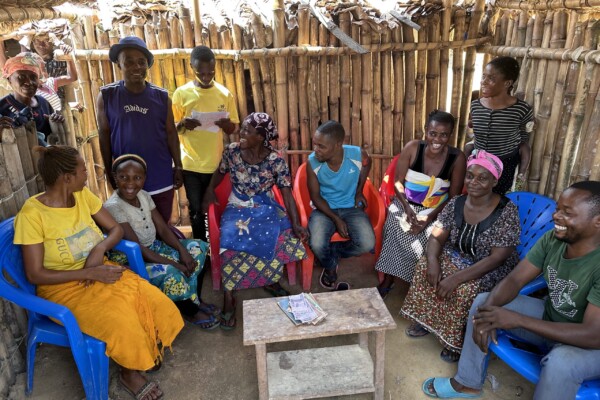
Unconditional Cash Transfers (UCT) in the DRC: A pilot study assessing the socio-economic effects in an artisanal mining zone of Maniema Province
October 16, 2024Building on previous experience in Uganda, the Belgian organisation Eight World vzw started in October 2021, an Unconditional Cash Transfer (UCT) pilot project in a village in an artisanal mining zone in the territory of Pangi, in Maniema province, in the eastern Democratic Republic of Congo (DRC). IPIS has undertaken a comprehensive study to evaluate key indicators related to the socio-economic,

Voix du Congo: Child labor in artisanal gold mines in the Mariminza chiefdom, Watsa territory: case studies of Menze and Babarau
July 16, 2024This research raises the issue of child labor in the artisanal mines in the chiefdom of Mariminza, using the examples of the Menze and Bararau quarries (Watsa territory, Haut-Uélé province). Using a qualitative approach based on several field interviews and a literature review, the study identifies the causes of child labor and its consequences for children’s future in order to propose preventive
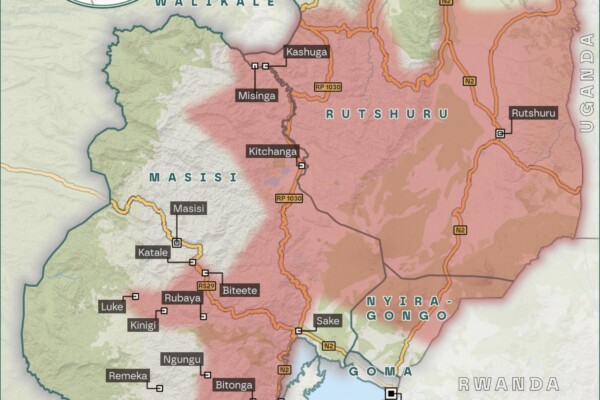
Shifting frontlines: Visualizing the evolution of the M23’s territorial influence in early 2024
June 20, 2024In early 2024, IPIS, ASSODIP, and DIIS published a report on the stakes and motivations of the “March 23 Movement” (M23), a rebellion causing serious insecurity and humanitarian suffering in the eastern Democratic Republic of Congo (DRC). The movement took up arms again in 2021, and it rapidly seized vast territories in the south-east of North Kivu province in 2022, with military support from the
The M23 “version 2” – Local stakes, motivations, perceptions, and impacts
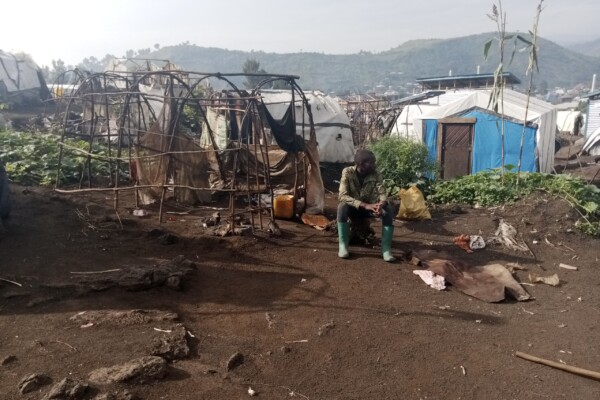
April 4, 2024Since 2021, the eastern part of the Democratic Republic of Congo (DRC) has once again fallen victim to the “March 23 Movement” (M23). Supposedly defeated in 2013, the M23 took up arms again in 2021, and by 2022 had rapidly seized vast territories in the south-east of North Kivu province.
Roadblocks in Masisi and Walikale: Predation on movement in turbulent times
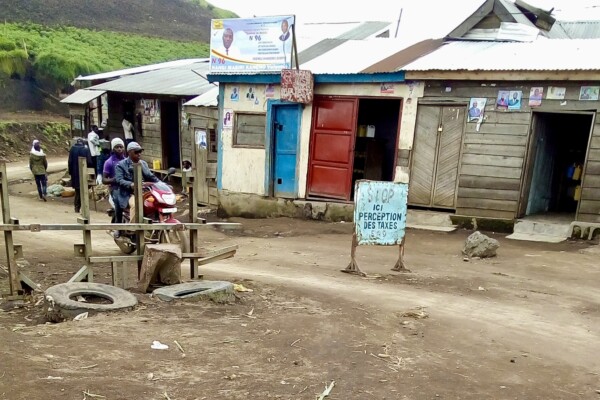
March 8, 2024While minerals have centered in research on conflict financing in the Democratic Republic of the Congo, armed actors often rely on alternative sources of revenue to finance their struggles. Among these are the operation of roadblocks. In this report, produced together with ASSODIP and the Danish Institute for International Studies, IPIS studies the linkage between roadblocks and the local artisana
Mining and conflict in the eastern DRC: An interactive story map
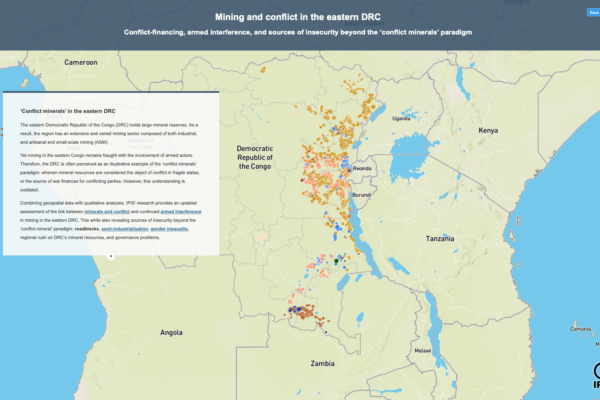
February 15, 2024Conflict-financing, armed interference, and sources of insecurity beyond the ‘conflict minerals’ paradigm In this story map, IPIS presents its findings on the linkage between mining and conflict-financing in the eastern Democratic Republic of the Congo (DRC). Based on a survey conducted between 2021-2023 of 829 active mining sites (representing over 132,320 artisanal miners), IPIS’ research provid
Kufatilia evolves into a civil society network, now equipped with a new platform to follow up on mining incidents
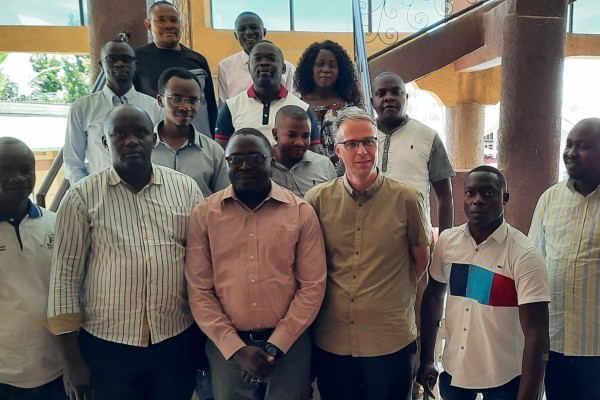
January 19, 2024First annual meeting of the newly established Kufatilia network In November 2023, IPIS’ Kufatilia partners traveled to Bunia and Bukavu in the eastern Democratic Republic of the Congo (DRC) to attend the first annual meeting of the newly established Kufatilia network. Consisting of two separate conferences in Ituri and South Kivu, the meeting brought together twenty-two partnered Congolese civil s

IPIS Event: Congolese cobalt, EU regulations, and direct investment
January 9, 2024On the 30th of November, IPIS hosted its annual panel discussion, this time on current challenges facing the cobalt sector in the Democratic Republic of the Congo (DRC) and the potential impact of European Union (EU) regulations to improve these. Moderated by Lotte Hoex, the panel consisted of Esperant Mwishamali, independent researcher on cobalt artisanal and small-scale mining (ASM) in the DRC,
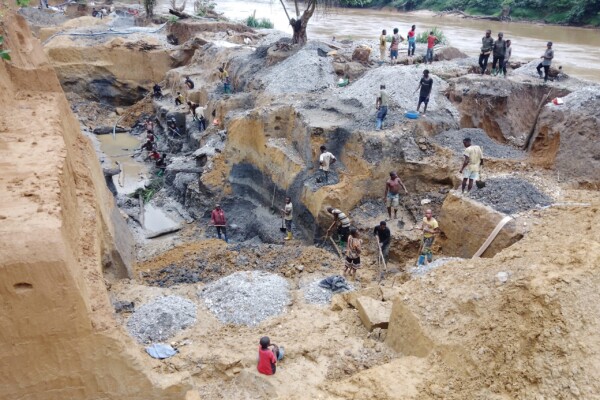
Analysis of the interactive map of artisanal mining areas in eastern Democratic Republic of Congo (2023 update)
December 22, 2023Since 2009, IPIS has mapped and collected data at more than 2,800 Artisanal and Small-scale Mining (ASM) sites in the eastern Democratic Republic of the Congo (DRC). In this report, IPIS provides its 2023 update of the state of ASM in the eastern DRC, based on data from over 829 ASM sites in the eastern DRC between 2021-2023. The study analyses linkages between mining, conflict, and insecurity in

Increasing awareness of policy reforms on gender equality issues in artisanal and small-scale mining in eastern DRC: Case study of the Numbi, Nzibira and Nyabibwe sites
December 13, 2023The mineral resources of the eastern Democratic Republic of the Congo’s (DRC) provide an important source of employment for both men and women involved in artisanal and small-scaling mining (ASM). Yet opportunities are not equal for men and women. Based on a series of interviews with various ASM stakeholders at the mines of Numbi, Nzibira and Nybibwe in the province of South Kivu, this