
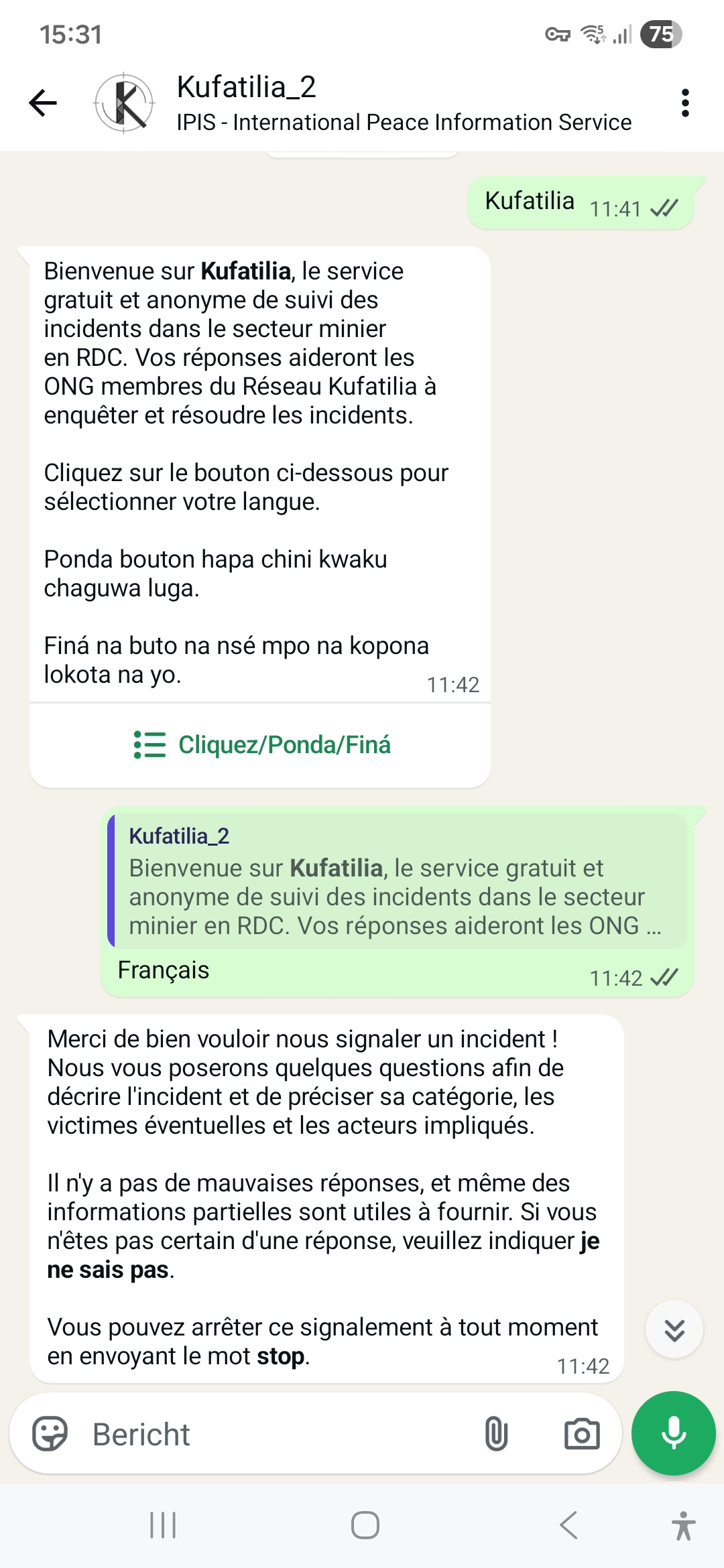
The Kufatilia incident reporting system allows anyone within the mining sector in DRC to report an incident by sending the keyword “kufatilia” via WhatsApp to +1 406 812-7349. The system automatically creates an incident survey which can be anonymously filled out by the informant in Swahili, Lingala or French.
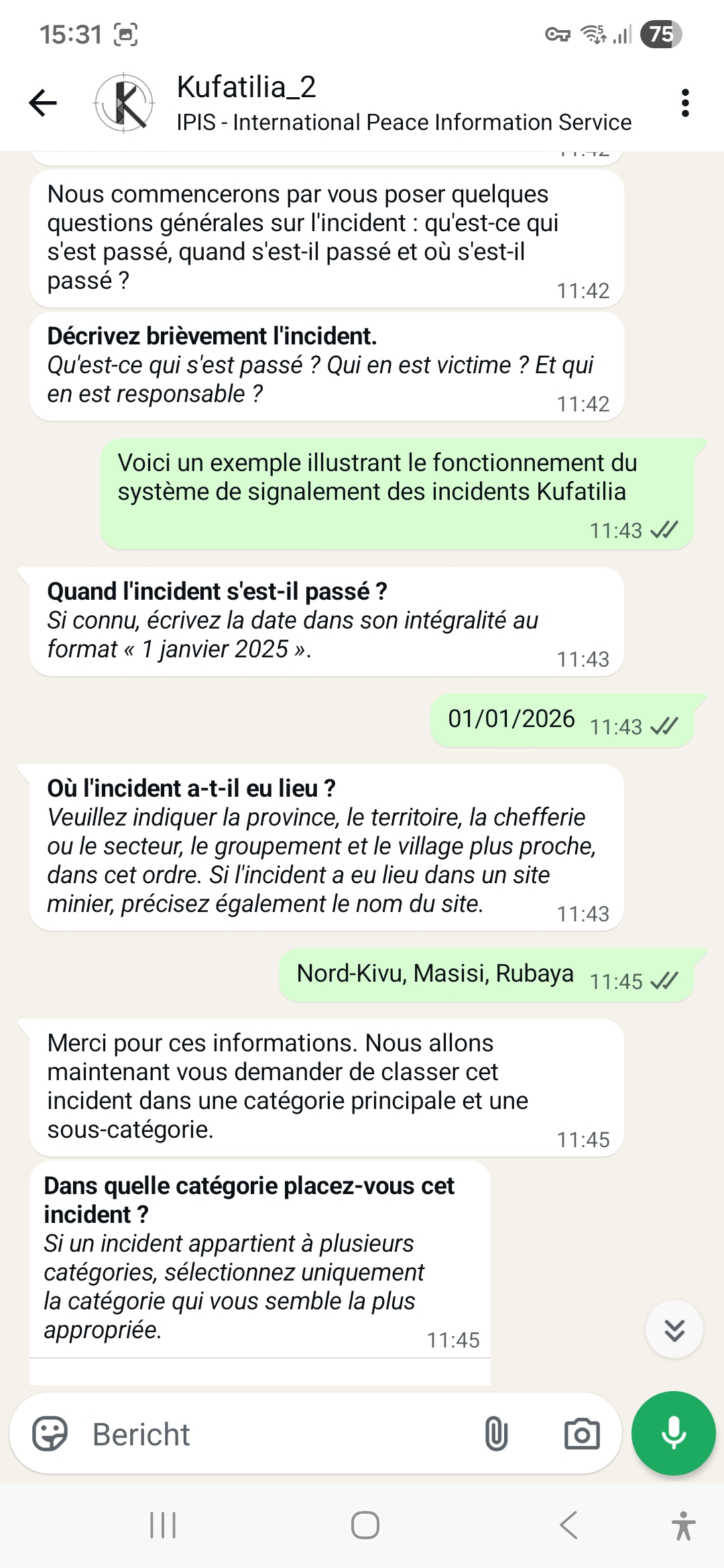
Informants are first asked to briefly describe the incident they wish to report. The survey then collects more detailed information, including when and where the incident occurred, who was responsible, and whether there were any victims. Informants are also asked to classify the incident by selecting a category and subcategory based on the type of issue reported.


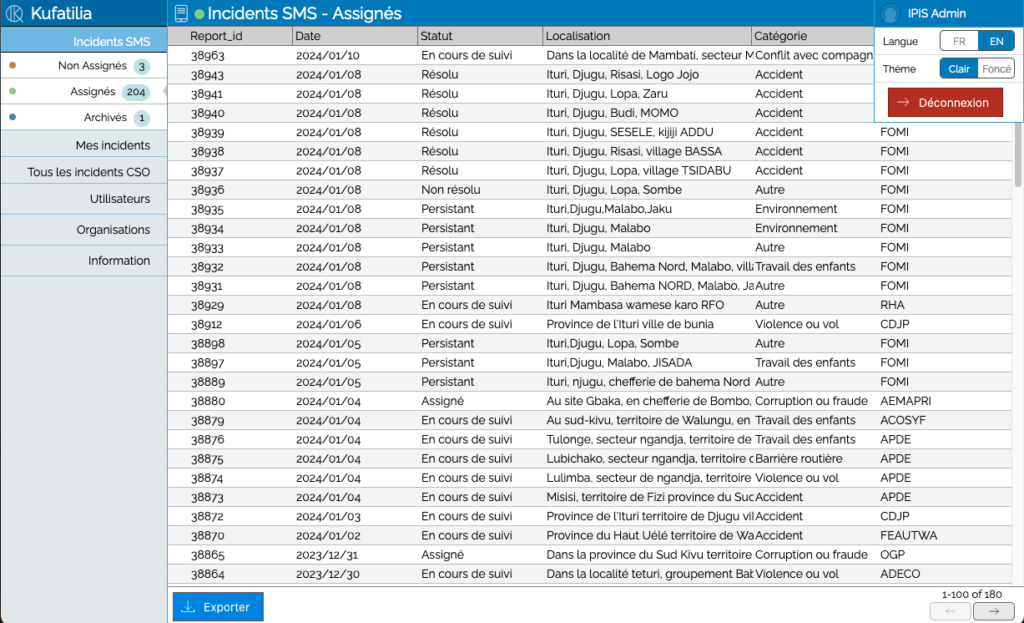
Secured online incident follow-up platform for the Kufatilia Network
All reported incidents are collected on an online password-protected platform. Once verified for clarity, completeness, and relevance to the mining sector, each incident is assigned to a Kufatilia Network member based on where the incident occurred.
These CSOs are tasked with:
- verifying the accuracy and details of the incident,
- further documenting the incident and following up on it,
- seeking to address it through mediation, contacting key actors, training or advocacy.
Usually, Kufatilia members involve local multi-stakeholder committees, such as the provincial or local mining monitoring committees in the documentation and resolution of an incident.
Once an incident’s follow-up is complete, the responsible CSO assigns it a final status. The status of the incidents can be the following:
- Resolved: The incident has been investigated by a Kufatilia member, and a satisfactory solution has been found for the parties involved.
- Unresolved: The incident has been investigated, but no satisfactory solution could be identified, although the issue is no longer ongoing.
- Ongoing: The incident was investigated by a Kufatilia member, but the organisation was unable to find a satisfactory solution to the problem, and unfortunately, the issue is still ongoing. This may occur when the root causes are beyond the control of local organisations, for example, when incidents are linked to broader dynamics such as the presence of armed groups or structural challenges like poverty-related child labour.
- Not monitored: The incident was reviewed by a Kufatilia member, but not actively investigated. This may occur when the incident is unrelated to the mining sector or when it takes place in an insecure or inaccessible area.
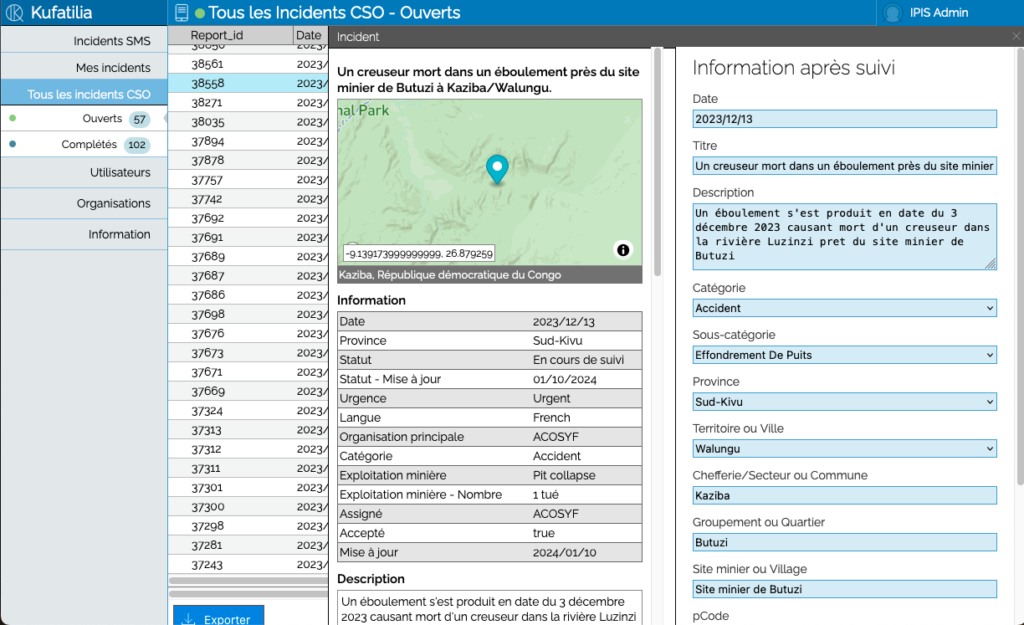
Through the secure online platform, Kufatilia members can access an overview of reported incidents across all provinces, enabling transparent and collaborative follow-up.
Secured online Kufatilia platform.
Public dashboard on mining-related incidents
To allow civil society, local authorities and other stakeholders to visualise confirmed incidents, IPIS has developed a public interactive dashboard.
On this dashboard, the evolution of the number of incidents reported through Kufatilia can be monitored, as well as different indicators such as their status (under monitoring, resolved/closed, unresolved, or persistent), their location, and their category.
The dashboard is intended to enable informational and non-commercial use of the incident data. However, we advise caution in the use of Kufatilia incident data for statistical purposes. Even if the dataset contains many incidents, it remains selective and is provided without any claim about its degree of coverage of all incidents in a certain location, period, or category. The absence of data does not imply the absence of actual incidents, but may simply be the result of limitations in the reporting chain. Therefore, you should exercise extreme caution when establishing trends or drawing conclusions based on this dataset.

MORE ABOUT KUFATILIA:

Kufatilia has been supported by multiple donors over the years, including the Belgian development cooperation, the European Union, the Dutch Ministry of Foreign Affairs, the European Partnership for Responsible Minerals (EPRM), and USAID.