
Initially launched as an incident reporting tool, Kufatilia evolved under the momentum of participating organisations into a true network of civil society organisations (CSO). Partners of the Kufatilia project formalised the creation of the Kufatilia network in November 2023 the first annual meeting in November 2023. This network aims not only to address individual incidents but also to engage relevant stakeholders in efforts to prevent incidents from recurring.
By joining forces more structurally, Kufatilia members are able to leverage each other’s experience in tackling incidents. The newly established network also aims to enable more coordinated approaches to awareness-raising on incident reporting as well as to civil society advocacy at the provincial and even national levels.

Vision
A Democratic Republic of Congo and a world where communities live in dignity, security, peace and equity, thanks to transparent, participatory and responsible governance of natural resources, that respects human rights, and with a civil society recognised for its active role in defending these principles.
Mission
The Kufatilia Network brings together Congolese civil society organisations engaged in observing and monitoring mining activities in the DRC.
We document incidents and human rights violations that occur in this sector. In collaboration with local stakeholders, we propose and monitor the implementation of appropriate solutions for each incident. Through our analyses, we identify trends, expose abuses and engage relevant authorities and partners to structurally address and prevent incidents. In doing so, we aim to contribute to safer living and working conditions for mining communities.
Members
The Kufatilia Network brings together 17 members working in four provinces in DRC: Ituri, North-Kivu, South-Kivu and Lualaba. IPIS provides the Network with financial and organisational support.
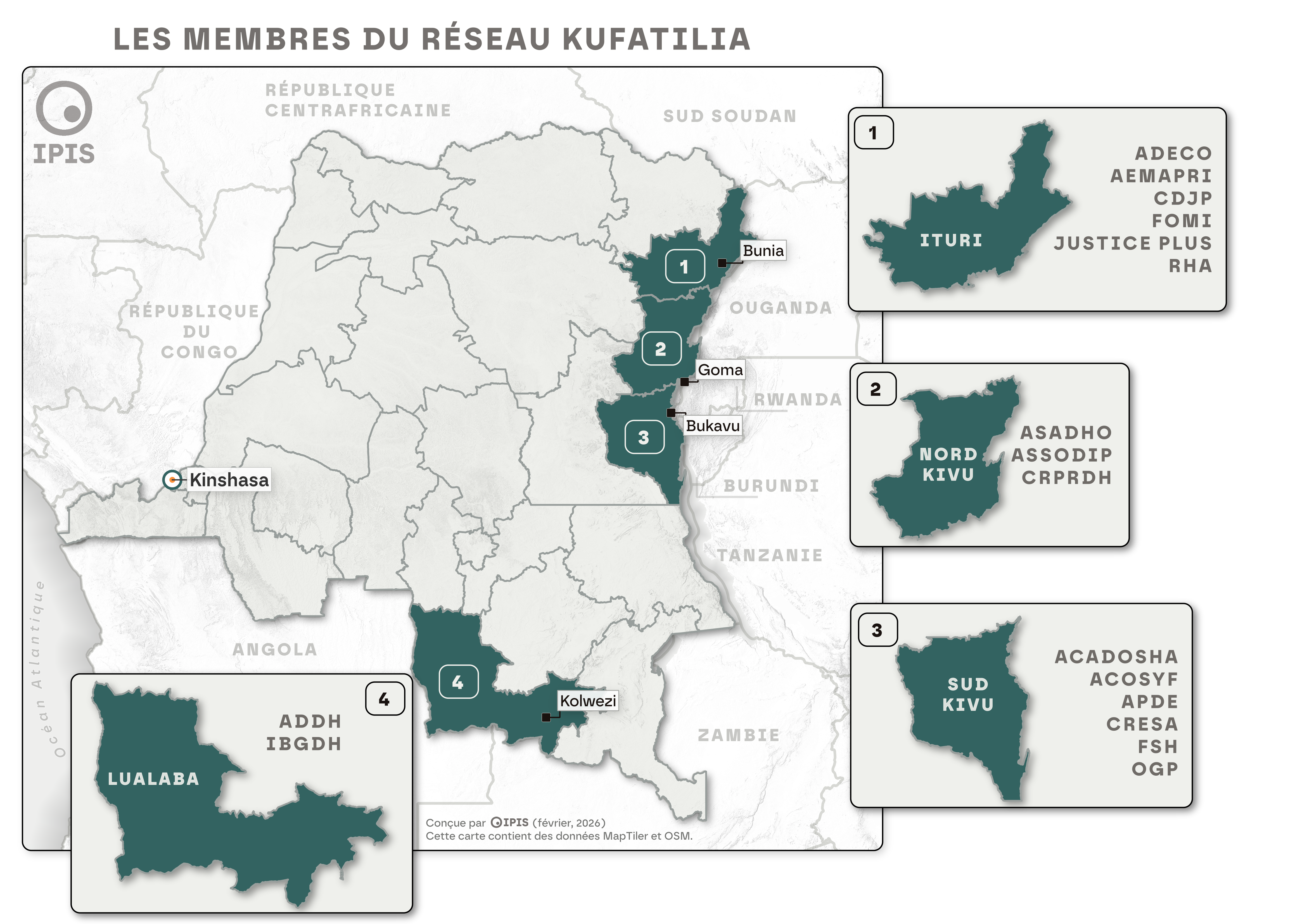
What do the Kufatilia members do concretely?
1. Awareness raising on the Kufatilia incident reporting system and its goals
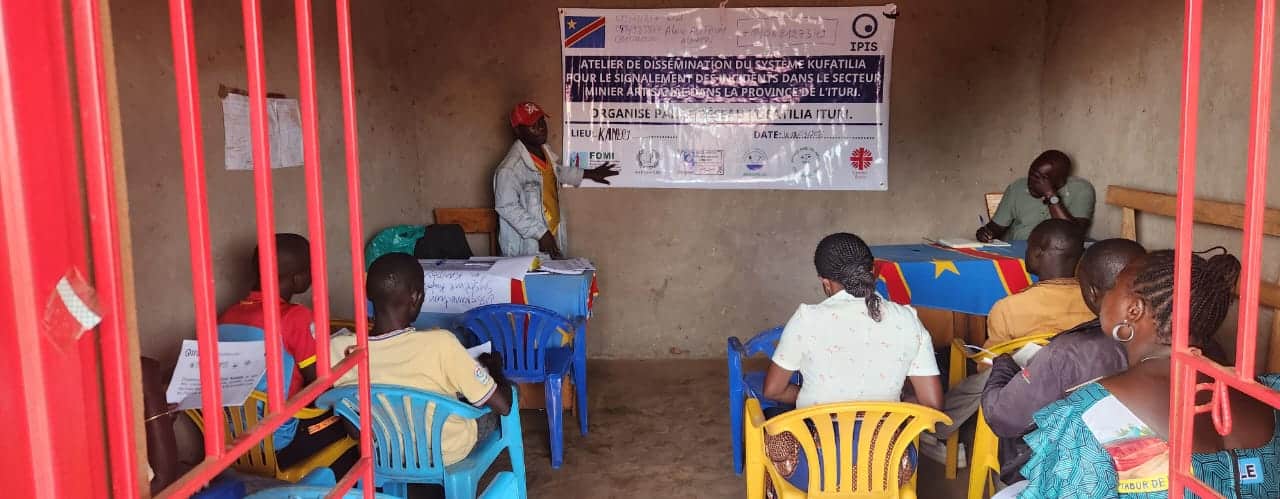
Through interactive workshops held in mining areas, Kufatilia members explain and show mining-affected communities and mining cooperatives how the Kufatilia system works, how an incident can be reported and how Kufatilia members follow up on reported incidents. To reach a broader audience, Kufatilia members also use radio broadcasts, flyers, banners and other communication means to raise awareness about the incident reporting system.
While incidents can be reported by any citizen, most incidents are, in practice, collected and reported by focal points from civil society organisations that are part of the Kufatilia Network. These focal points live and work in mining areas and regularly identify and report incidents occurring in their communities.
2. Incident monitoring and follow-up
Reported incidents are assigned to a member of the Kufatilia Network based on the location where they occurred. Each network member covers a specific area within a province and is responsible for documenting and following up on all incidents in that zone.
The monitoring of an incident by members of the Kufatilia Network consists of
- verifying the accuracy and details of the incident,
- further documenting the incident and following up on it,
- seeking to address it through mediation, contacting key actors, training or advocacy.
Key actors in the mining sector, such as local authorities, cooperatives, and local or provincial mining monitoring (sub)committees, are mobilised in this work. Kufatilia members present both individual cases and broader incident trends to provincial mining monitoring committees (Comités Provinciaux de Suivi des Activités Minières), where government representatives, security services, cooperatives, mining companies and CSOs meet to discuss and address challenges in the mining sector.


The status of the incidents can be the following:
- In monitoring: This incident is currently being investigated by a Kufatilia Network member.
- Resolved: The incident has been investigated by a Kufatilia member, and a satisfactory solution has been found for the parties involved.
- Unresolved: The incident has been investigated, but no satisfactory solution could be identified, although the issue is no longer ongoing.
- Ongoing: The incident was investigated by a Kufatilia member, but the organisation was unable to find a satisfactory solution to the problem, and unfortunately, the issue is still ongoing. This may occur when the root causes are beyond the control of local organisations, for example, when incidents are linked to broader dynamics such as the presence of armed groups or structural challenges like poverty-related child labour.
- Not monitored: The incident was reviewed by a Kufatilia member, but not actively investigated. This may occur when the incident is unrelated to the mining sector or when it takes place in an insecure or inaccessible area.
Reported incidents are classified into different categories and sub-categories:
- Accident (subcategories: traffic accident, asphyxia, machinery failure, landslide, pit collapse, drowning, and use of explosives)
- Child labour (subcategories: surface digging, underground digging, treating minerals, collecting minerals, transporting minerals, operating machinery, use of toxic products such as mercury, and non-mining work)
- Conflict with industry (subcategories: environmental damage, intrusion on industrial mining concession, and violation of relocation agreements)
- Corruption or fraud (subcategories: fraud in the declaration of mineral origin, fraud in the declaration of production numbers, bribes, illegal taxation, and the sale of traceability programme tags)
- Environmental problem (subcategories: poaching, deforestation, environmental damage, unfilled mining pits, pollution, and the use of toxic products such as mercury)
- Roadblock (subcategories: abuse of power, arbitrary arrest, bribes, illegal taxation, and violence)
- Theft (subcategories: extortion, looting, armed theft, and unarmed theft)
- Violence (subcategories: armed attack, fight or quarrel, vigilantism, kidnapping, murder, torture, forced labour, and sexual violence)
- Other
More about Kufatilia:

Kufatilia has been supported by multiple donors over the years, including the Belgian development cooperation, the European Union, the Dutch Ministry of Foreign Affairs, the European Partnership for Responsible Minerals (EPRM), and USAID.